How to find crochet and knitting pattern testers when you do not have a following
Nobody knew who I was either. Here is how I found pattern testers.
You do not need an audience to find pattern testers. Reddit has r/PatternTesting, which works for any craft and does not care how many followers you have, and there are Instagram accounts and Facebook groups that circulate tester calls. What decides whether people apply is the call itself: a photo of the finished item, the yarn weight and hook size, the deadline, and what the tester gets out of it.
Where to look
There are places designers and testers already find each other, and they cost nothing.
Reddit. r/PatternTesting exists for exactly this. It is not tied to one craft, so knitters and crocheters both use it. The people reading it are there specifically to test patterns, which is a better filter than any algorithm, and follower count does not come into it at all. I got surprisingly good results there.
Instagram. There are accounts that do nothing but circulate tester calls. A few: crochettestercall, testercalls_patterngiveaways, alltestercalls.
Facebook. There are groups, including Crochet Pattern Testers and Pattern Testers.
Those are the ones I go to and there are more than these. The Instagram accounts and the Facebook groups I use are crochet ones, because crochet is what I design, so if you knit, look for the knitting equivalents. They exist and they work the same way.
Every one of them has its own rules about how a tester call should be posted, so read those before you write yours.
What goes in the call
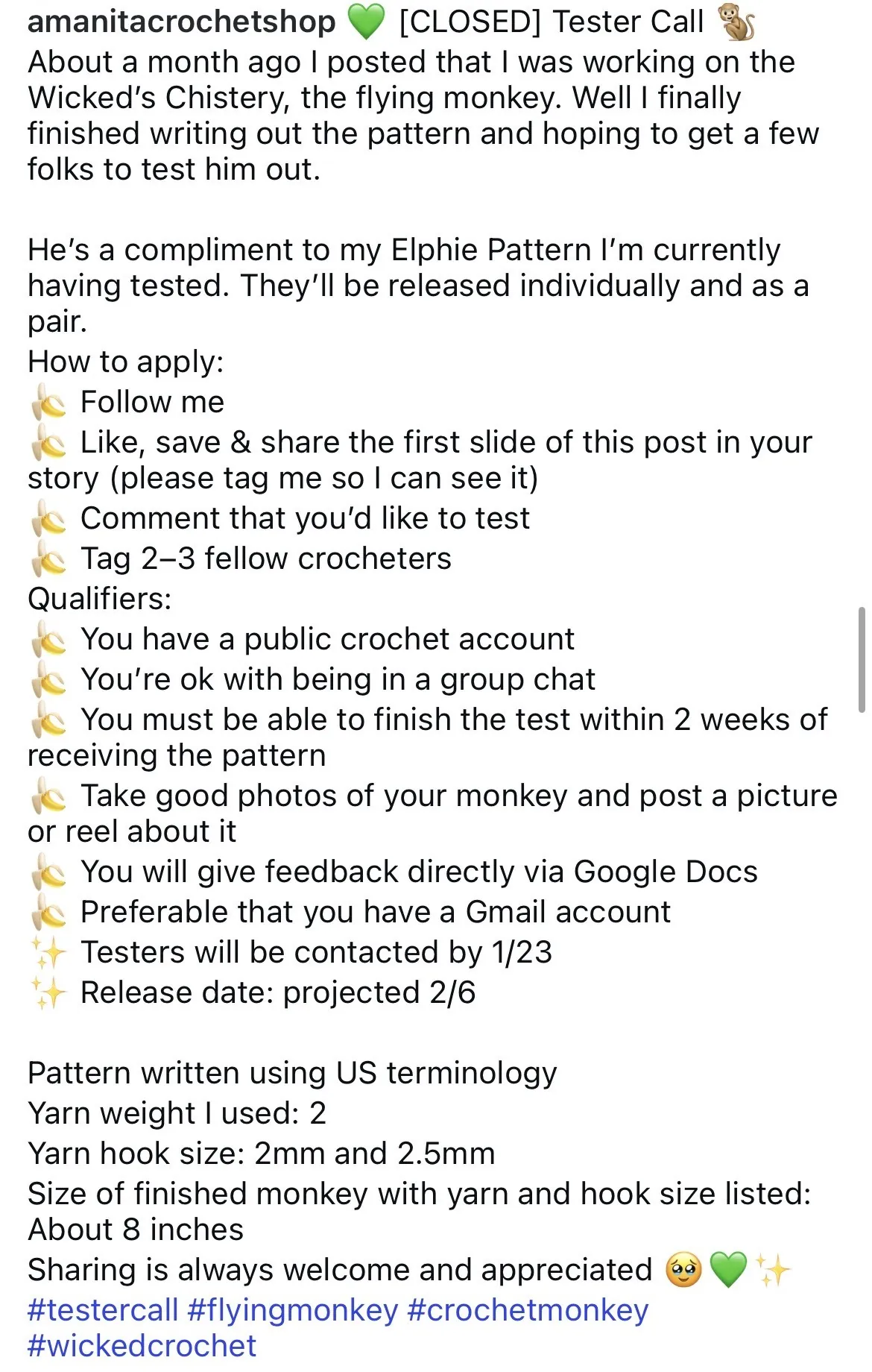
The group rules tell you the format. They do not tell you what a person needs to know in order to say yes. Here is what mine contain.
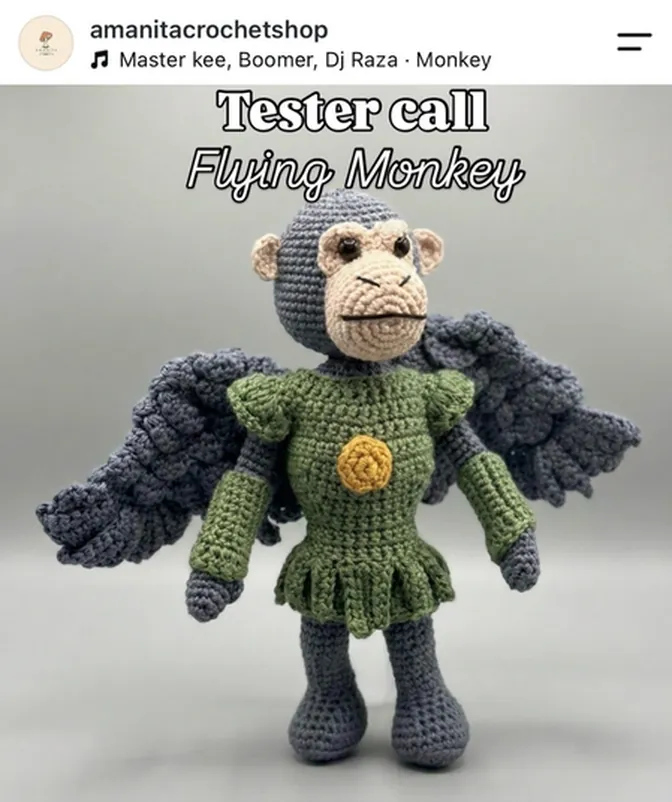
A photo of the finished item, as the first slide. This is the whole thing. Nobody signs up for a shape they cannot picture, and it is the slide people share.
One sentence about what it is. Not a pitch. Mine say something like: this little guy is meant to be the companion for my graduation doll. It costs a line and it is the difference between a listing and a person asking for help.
What the tester gets. Featured in the pattern listing itself, which is the one that keeps working for them after the test is over. A shout out on my socials. And usually a free copy of the finished pattern once it is updated.
How to apply. Follow, like, save, share the first slide to your story and tag me so I see it, comment that you want to test, and tag two or three other crocheters. The share and the tags are how these posts travel, which is why almost every tester call asks for them.
The qualifiers. This is where the real work is:
- A public crochet account
- Willing to be in a group chat
- Can finish the test within the window, which for me is two to three weeks depending on the pattern
- Will take good photos of the finished item and post a picture or a reel
- Will give feedback directly in the Google Doc I send
- Preferably has a Gmail account, since the feedback lives in a doc
- The date I will contact testers by
- The projected release date
The pattern details, so somebody can tell whether they can actually make it:
- US or UK terminology
- The yarn weight I used
- The hook size, and whether that is the only one
- The finished size
Hashtags, which is how anybody who does not already follow you finds the call. Mine are usually #testercall plus the craft and the subject.
Those two lists are what stop the wrong applications. Somebody who does not own a 2.5mm hook, or would rather not be in a group chat, finds that out before they apply instead of three weeks later.
One small thing that costs nothing: when the call closes, edit the caption and put [CLOSED] at the front of it. People find these posts weeks later.
Here is one of mine, as it actually went out. Yours should sound like you rather than like me.
How many people actually apply
I should be honest about the scale here, because the honest version is the useful one.
I am not a big name designer. My following is small, and when I started running tester calls it was smaller. I did not always get a lot of people applying, and on some calls I got fewer than I wanted.
The part nobody mentions about Instagram tester calls is that the reach is mostly not yours. Whether your call finds anybody depends on whether the accounts that circulate tester calls pick it up and repost it. That is out of your hands, and it is hardest exactly when you are new, which is when you need testers most.
So if you are starting out, do not put everything on Instagram. Reddit and the Facebook groups do not care how many followers you have.
And when four people apply and you wanted five, the question of how to choose between them answers itself. Most of the choosing was done by the qualifiers anyway. If the call says public account, group chat, a deadline you can meet, photos posted and feedback in a Google Doc, then everybody who applied has already agreed to all of it. That is not a filter you run afterward on a pile of applications. It runs itself, and it is the reason I would rather write a long qualifier list than a short friendly one.
For what it is worth, I aim for at least five testers.
Once you have them
Finding testers and running the test are two different jobs, and I wrote the second one up separately.
The short version: send them the finished PDF rather than a draft in a document, ask questions specific enough to answer in one sentence, put everyone in one shared space instead of five separate inboxes, and check your own stitch counts before any of it, because a tester is not a tech editor.