A knitting chart maker that writes every row, RS and WS
NodeStitch is pattern design software with a knitting chart maker built in. You draw lace, cables or colorwork with Craft Yarn Council or Japanese (JIS) symbols, and the Written tab writes every row out with RS and WS labels, wrong side stitches, repeats and stitch counts. Drawing lace, cable, colorwork and stitch charts is free, up to 300 x 300.
How I built knitting charts without being a knitter
I’ll be upfront: I crochet, I don’t knit. Everything here was built from the Craft Yarn Council’s chart symbols, Vogue Knitting’s stitch key, and a lot of testing against how published knitting patterns actually write their rows. When something came back reading wrong, it got changed until it read the way a knitter writes it.
That’s also why I want to hear from you if you knit and something here looks off.
A chart and its written rows, side by side
The first chart in the video is a cabled lace panel: edge stitches, 2/2 RC and 2/2 LC cables, twisted knit stitches up each side, and a lace panel of yarn overs and decreases in the middle.
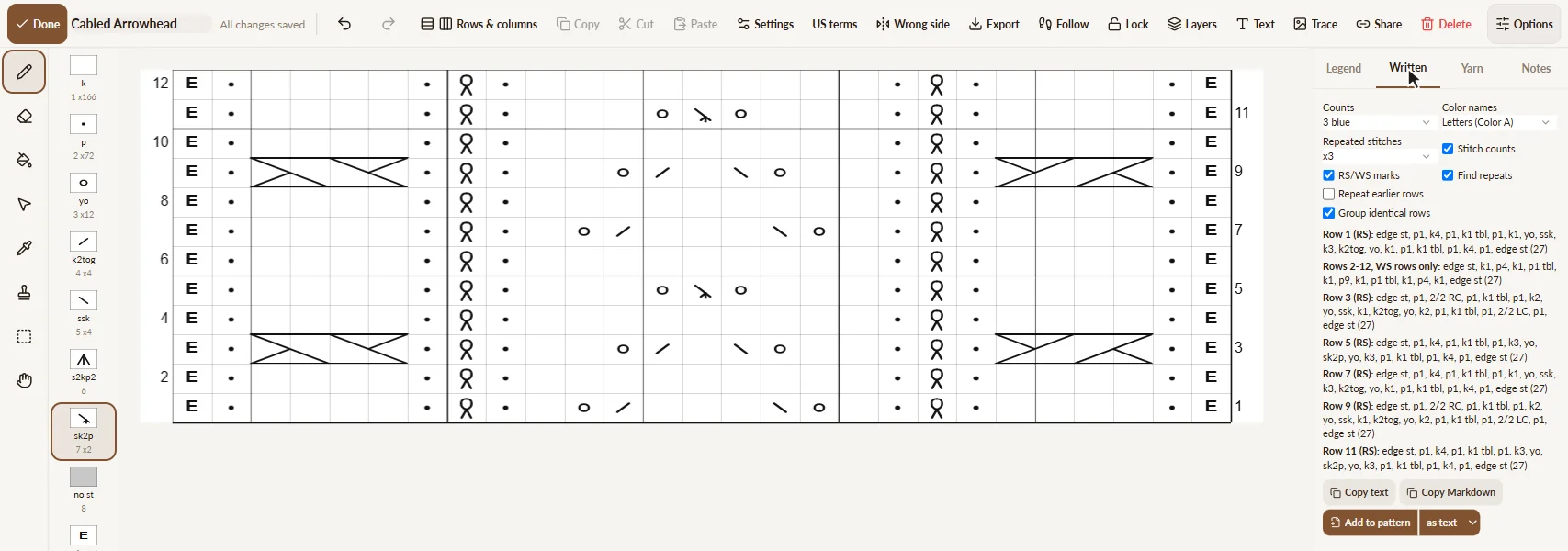
The Written tab reads it like this:
- Row 1 (RS): edge st, p1, k4, p1, k1 tbl, p1, k1, yo, ssk, k3, k2tog, yo, k1, p1, k1 tbl, p1, k4, p1, edge st (27)
- Rows 2-12, WS rows only: edge st, k1, p4, k1, p1 tbl, k1, p9, k1, p1 tbl, k1, p4, k1, edge st (27)
- Row 3 (RS): edge st, p1, 2/2 RC, p1, k1 tbl, p1, k2, yo, ssk, k1, k2tog, yo, k2, p1, k1 tbl, p1, 2/2 LC, p1, edge st (27)
Notice the WS rows. The chart shows the right side, so a purl dot on a WS row is knit, and k1 tbl becomes p1 tbl. You don’t have to work that out, and the identical WS rows are grouped into one line.
Here’s what it handles for you:
- RS and WS labels on every flat row, or none in the round.
- Wrong side stitches. The legend says what each symbol is on a WS row: “knit; on WS: p (purl)”. Wrong side (W) in the editor shows the whole chart from the back.
- Cables by name, with which way they cross: “2/2 RC: right cross: slip 2 to a cable needle and hold in back…”.
- Repeats. A repeat to the end of the row is “*k3, M1L; rep from * to end” (“around” in the round). A short one goes in brackets: “k4, [p2] 3 times, k2 (12)”. A repeat never splits a run of one stitch, so it reads “k1, [p2, k2] twice, p2, k1”.
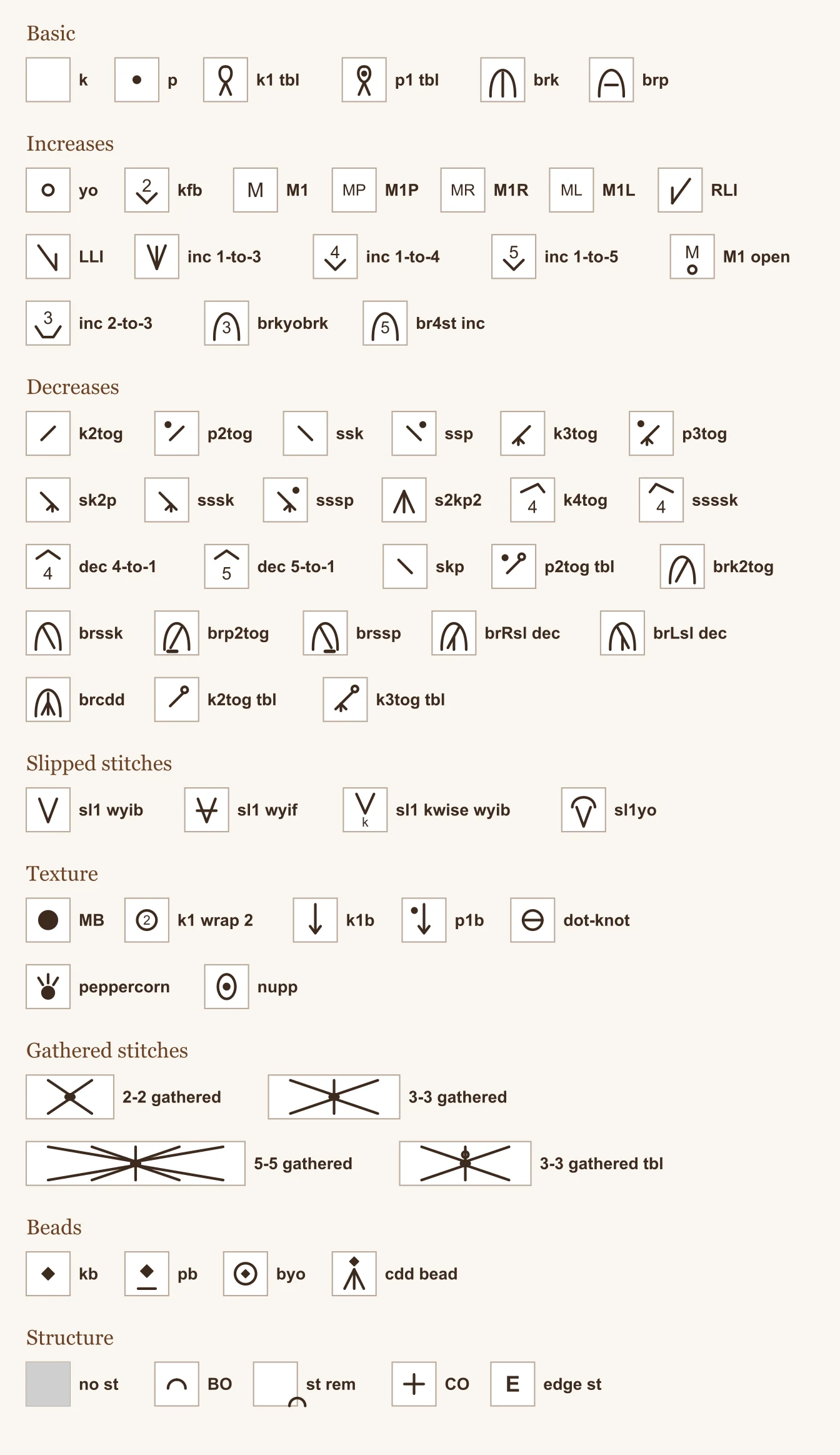
- Lace stitches beyond the basics: Estonian nupps, gathered stitches (2 into 2, 3 into 3, 5 into 5), k2tog tbl and k3tog tbl, and beads, such as a beaded centered double decrease.
- No stitch squares don’t break a run, so seven purls with a gap in the chart still read “p7”.
- A cast on row is written as the cast on: “Rnd 1: With Color A, cast on 12 sts and join to work in the round.”
Colorwork, in the short form colorwork patterns use
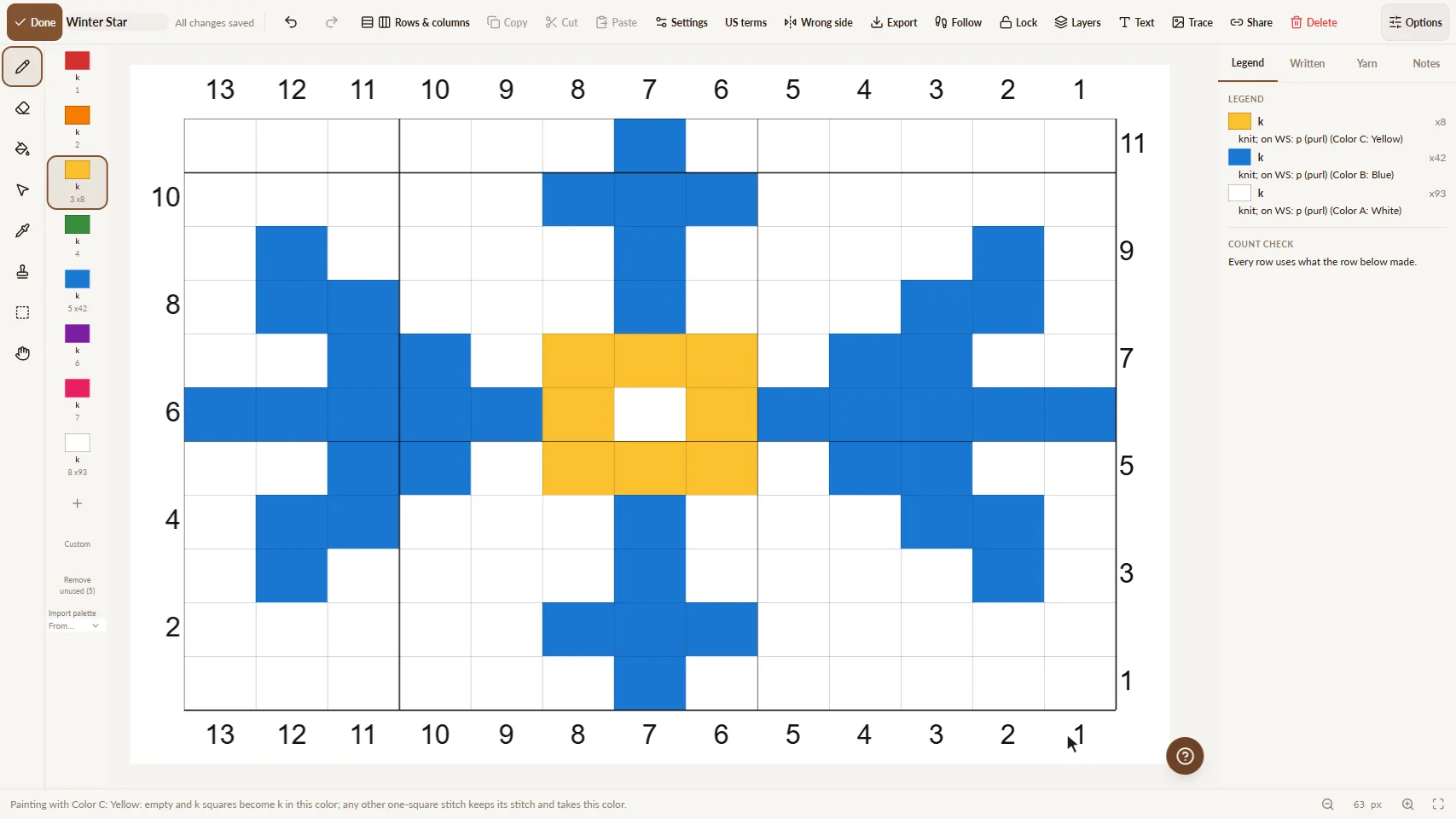
A new colorwork chart starts white, so you paint the motif onto a plain background instead of filling it in first. On a colorwork chart the background, the color knit in the most stitches, is always Color A, the main color. The other colors follow in the order they’re first knit. That star chart reads:
- Row 3 (RS): 1 Color A, [1 Color B, 4 Color A] twice, 1 Color B, 1 Color A (13)
- Rows 5 and 7 (RS): 2 Color A, 2 Color B, 1 Color A, 3 Color C, 1 Color A, 2 Color B, 2 Color A (13)
When the stitches have colors too, a row in one color says it once, “With Color A, k3, M1L, k3, M1L (8)”, and a row in several colors names each color where it changes, “k1 A, p2 B, k2 A (5)”. A chart with lots of stitches in lots of colors gets a legend in two lists, Colors and Stitches, the way colorwork patterns print a key, instead of one line for every stitch and color pair.
You can also call a color by its name instead of its letter. Under Color names, pick Names and the rows say “Forest Green” instead of “Color A”.
A mosaic shawl, in color or book style
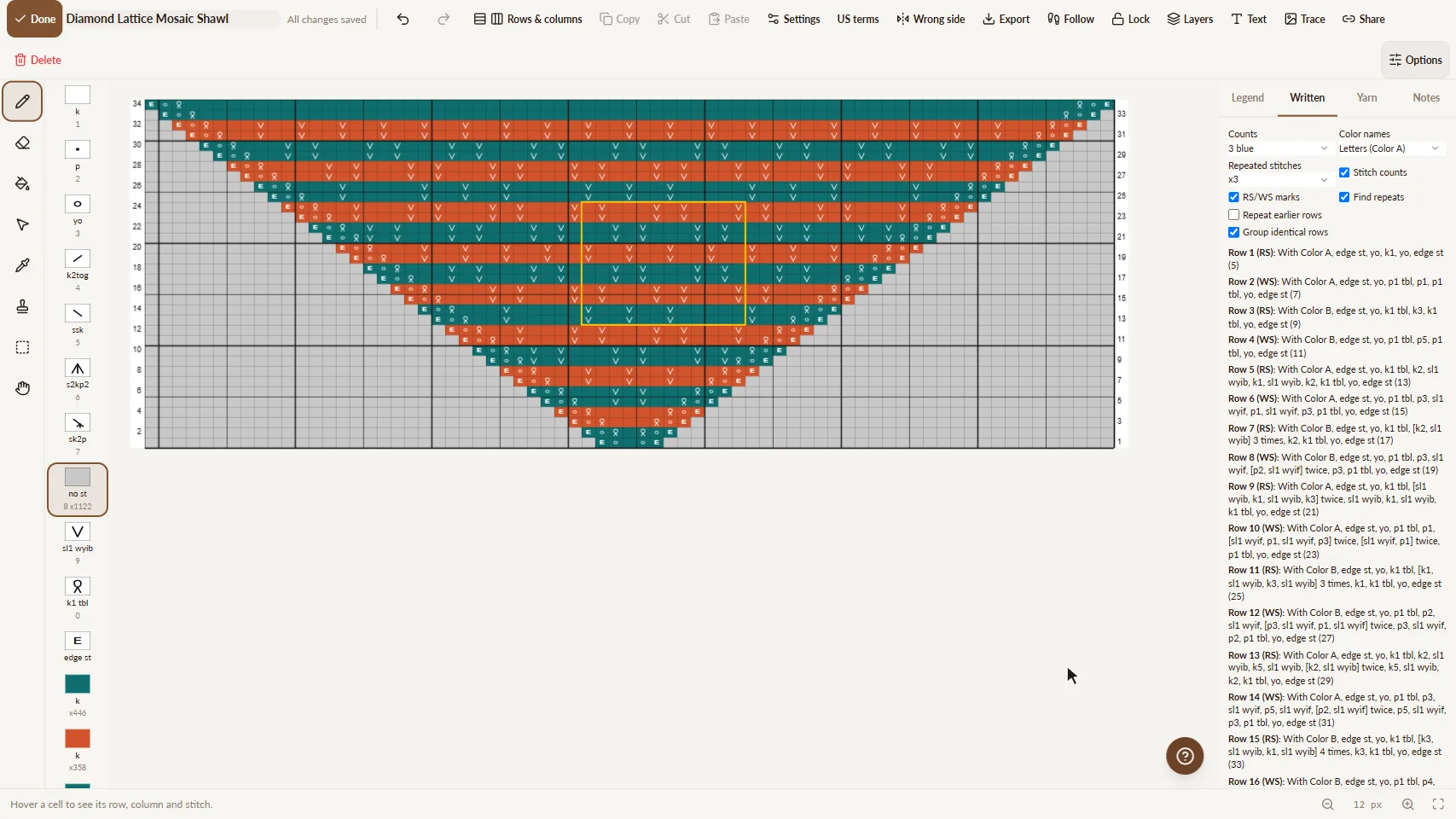
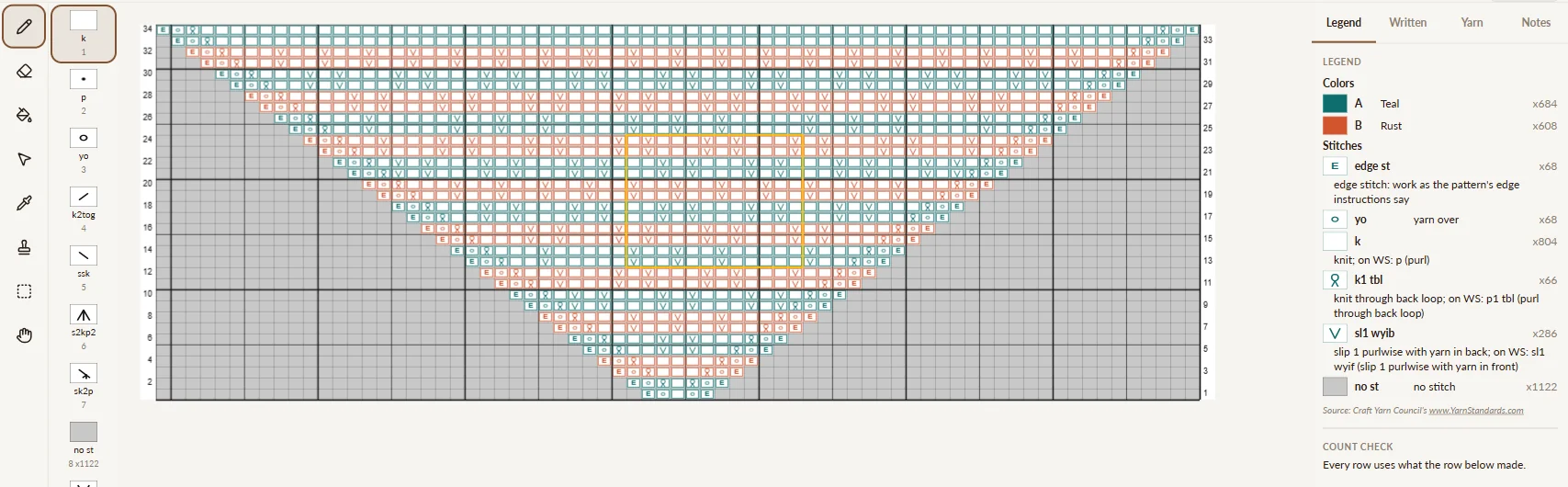
The second video charts a mosaic triangle shawl: 2 row stripes in teal and rust, slipped stitches carrying the pattern, a yarn over and a twisted stitch inside each edge on every row, and a 12 by 12 diamond lattice repeat.
A yarn over inside each edge adds 2 stitches every row, (5), (7), (9) and on up, and no stitch squares give the chart its triangle shape. The slipped stitches flip on the wrong side, “sl1 wyib” on RS rows and “sl1 wyif” on WS rows:
- Row 7 (RS): With Color B, edge st, yo, k1 tbl, [k2, sl1 wyib] 3 times, k2, k1 tbl, yo, edge st (17)
- Row 8 (WS): With Color B, edge st, yo, p1 tbl, p3, sl1 wyif, [p2, sl1 wyif] twice, p3, p1 tbl, yo, edge st (19)
If you’d rather your chart look like the ones in knitting books, turn on Draw symbols in their yarn color in Settings. The squares go white, each symbol is drawn in its yarn’s color, and each square gets a thin box in that color too, so a plain knit square still shows which yarn it is.
There’s also a dedicated Mosaic knitting chart type for slip stitch mosaic in the classic style, where each chart row is a RS row and the WS row that repeats it. That one, two color brioche and machine punch cards are Pro.
On the page and in the PDF
Add to pattern puts the written rows on your pattern page, as text or as a table, and each line stays linked to its chart row. Change the chart and the lines you haven’t edited change with it. The rows keep their RS and WS marks.
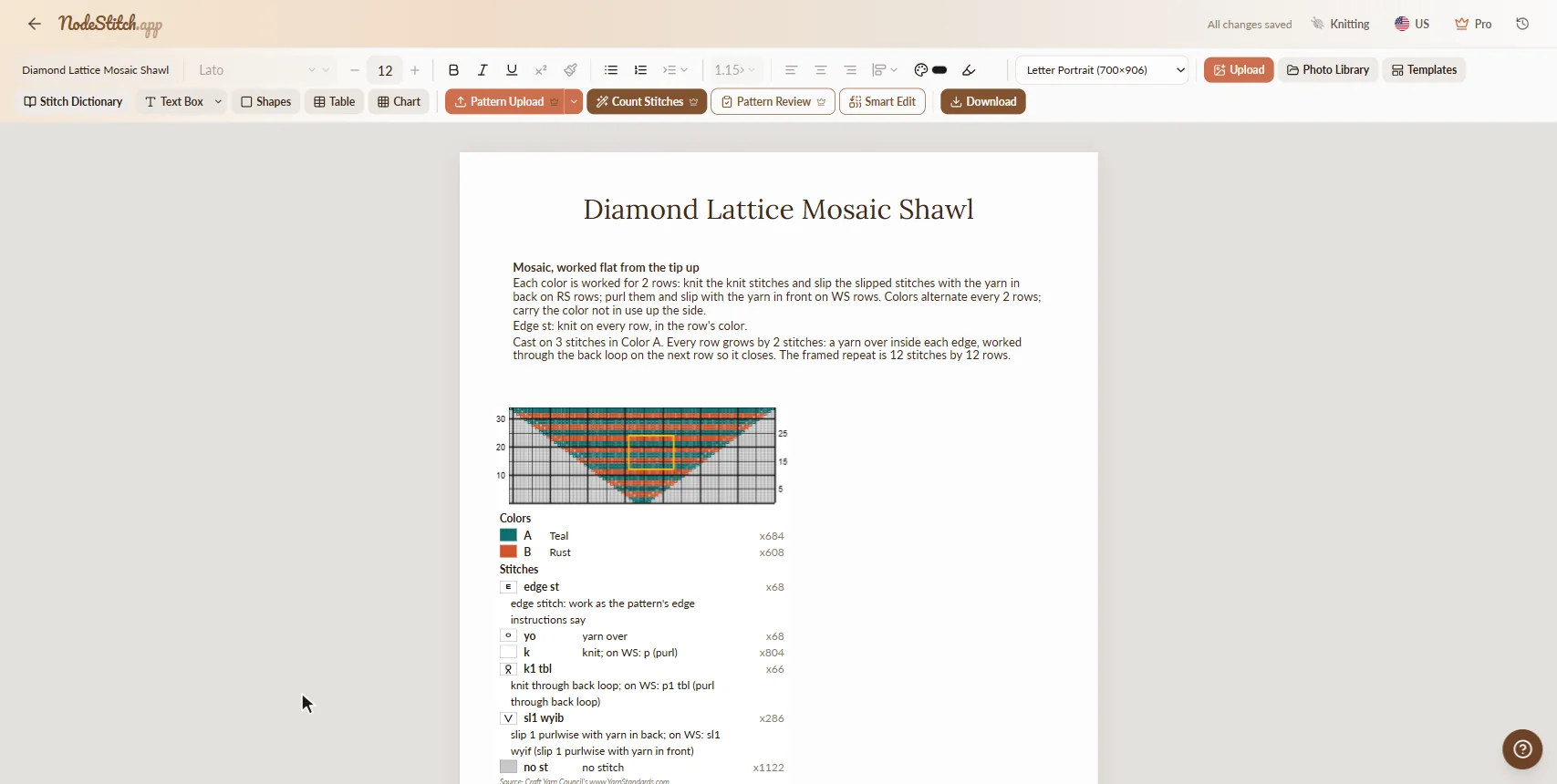
A few other things for knitters:
- Knitting projects start in rows. New Pattern boxes and tables in a knitting project are numbered in rows, not rounds.
- Flat rows before you join. A chart in the round can start with flat rows, for a shawl, hat or yoke worked flat for a few rows first. Set it to 2 and Rows 1 and 2 are written as “Row 1 (RS)” and “Row 2 (WS)”, then “Join to work in the round, being careful not to twist.”
- Symbol sets. Craft Yarn Council, its alternative drawings, or Japanese (JIS), where knit is a vertical bar and purl a horizontal one. Stitches the Council’s set doesn’t have, like SKP, peppercorn and knit 1 below, come from Vogue Knitting’s key.
- Yarn amounts. The Yarn tab estimates the yarn and skeins for each color from a swatch you measure, lists Color A first like the legend, and fills in skein lengths for many named yarn lines. Free charts have it too.
- Big charts print readably. A large chart can split across pages, at least 3 mm a square when it shows symbols, so a portrait page holds up to 60 x 80 stitches.
Knitting charts on your phone
The NodeStitch iPhone app builds knitting charts as well as following them. The same lace, cable and colorwork symbols are in the phone’s stitch picker, and the written rows come out the same as on the website. In Follow mode the chart sits on top with the row you’re on written underneath. Repeat boxes show on the phone and are written out, but you draw them on the computer, and the phone doesn’t have the Wrong side view.
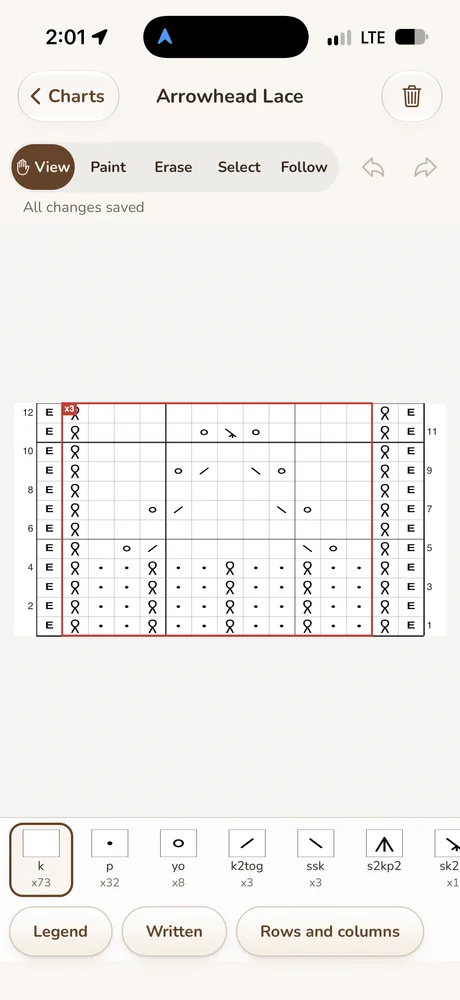
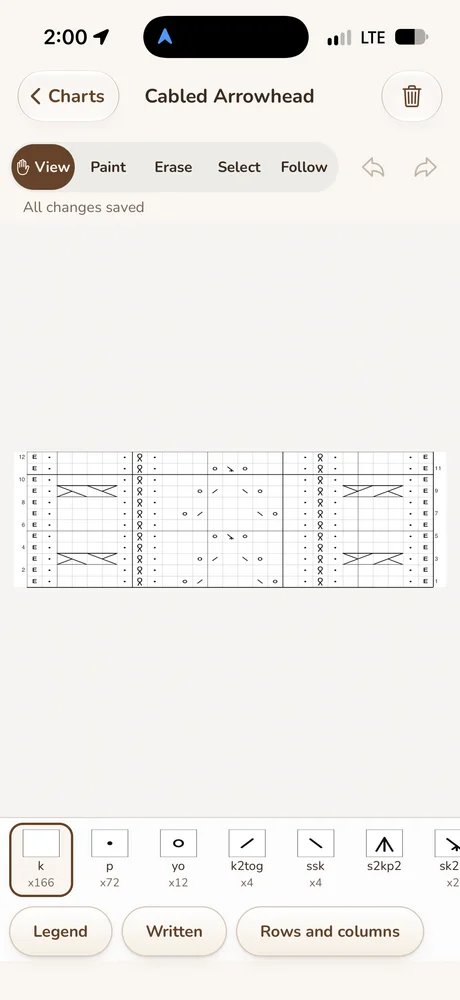
Below are an arrowhead lace chart with its repeat box and the same lace with cables added, on an iPhone.

What’s free and what’s Pro
Drawing any colorwork, lace, cable or stitch chart is free, up to 300 x 300, with every tool, the legend, the count check, the yarn estimate and the first three rows written out. Pro is $9.99 a month or $99 a year and gives you every written row, Add to pattern, charts up to 1,000 x 1,000, custom stitches, and the mosaic, brioche and punch card chart types. If you only need one chart finished, you can unlock that one chart for $2.99 instead.
How to read a knitting chart
Each square is one stitch, and the chart shows the right side of the work. Read flat charts from the bottom up: RS rows from right to left, WS rows from left to right, working each symbol as its wrong side stitch. In the round, every round is read from right to left, because you’re always on the right side. The legend says what each symbol means on both sides.
| Abbreviation | Stitch |
|---|---|
| k / p | knit / purl |
| yo | yarn over |
| k2tog | knit 2 together |
| ssk | slip, slip, knit |
| sk2p | slip 1, knit 2 together, pass slipped stitch over |
| k1 tbl / p1 tbl | knit / purl through the back loop |
| 2/2 RC / 2/2 LC | 2 over 2 right / left cross cable |
| sl1 wyib / sl1 wyif | slip 1 with yarn in back / in front |
| M1L | make 1 left |
| edge st | edge stitch |
Every knitting symbol in NodeStitch
These are drawn by the app itself, in the Craft Yarn Council style. Each one is in the palette, and the legend prints what it means on both sides.
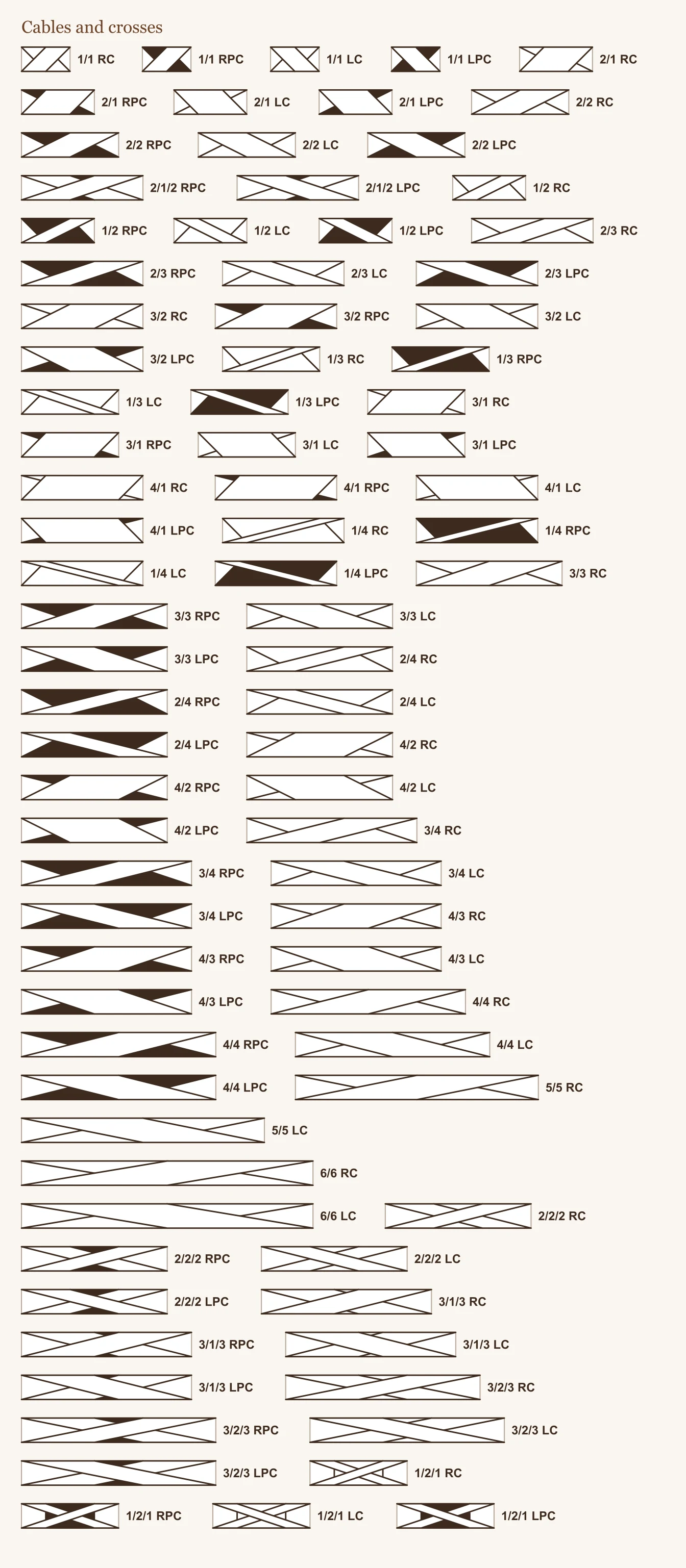
And every cable and cross, from 1/1 up to 6/6, including the purl crosses (RPC and LPC) and the 2/1/2, 2/2/2, 3/1/3, 3/2/3 and 1/2/1 crosses with a center stitch:
Knitting chart questions
Can it turn a knitting chart into written instructions?
Yes. The Written tab writes every row out as you draw, with RS and WS labels, repeats and stitch counts. Free accounts see the first three rows, and Pro sees them all.
Is it free?
Drawing lace, cable, colorwork and stitch charts is free, up to 300 x 300. Pro is $9.99 a month or $99 a year, or you can unlock one chart for $2.99.
Does it use Japanese (JIS) symbols?
Yes. In Settings, pick Japanese (JIS) as the symbol set, or Craft Yarn Council and its alternative drawings.
Can it chart mosaic knitting?
Yes, two ways: slipped stitches on a regular chart, like the shawl above, or the Pro Mosaic knitting chart type.
Can I add my own stitches?
Yes, on Pro. Draw a symbol of your own and give it stitch counts, and it goes in the legend and the written rows.
Does it write the pattern for me?
It writes out the rows you drew, with fixed rules, so the written pattern always matches your chart. The design is yours.
The stitch charts help article has the details, and you can start a chart here.