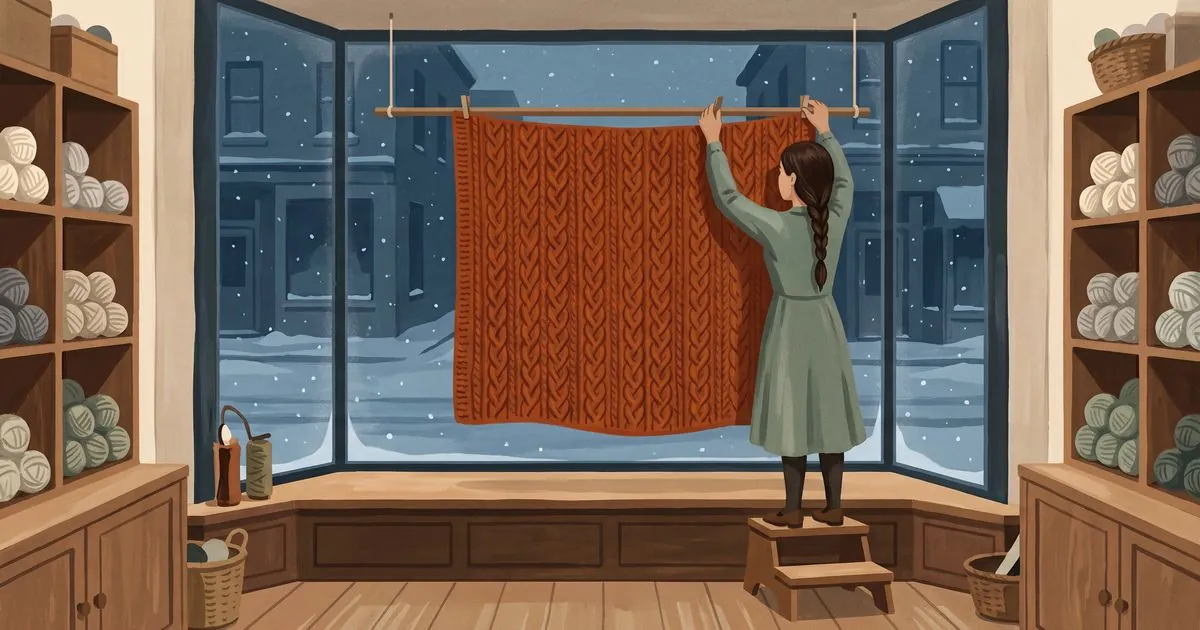
A Tunisian crochet chart maker that writes out every row
NodeStitch is pattern design software with a Tunisian crochet chart maker built in. Each square is one stitch of the forward pass, and the Written tab writes every row the way Tunisian patterns are written: the first loop isn’t counted, rows end “work end st”, colors change on the return pass, and cables like C4F are written by name. Repeats are found for you.
How to read a Tunisian crochet chart, and why it needs its own chart type
A Tunisian row isn’t a crochet row. You pick up loops on the forward pass and work them off on the return, the loop already on the hook counts as the first stitch, and the last stitch is worked differently from the rest. A regular crochet chart gets all of that wrong, and a chart that charts both passes (1F, 1R, 2F, 2R) doubles the rows for no reason when almost every return pass is the same.
So on a Tunisian chart in NodeStitch:
- Every square is one stitch of the forward pass.
- Every row ends with the standard return pass, so the return isn’t charted.
- Rows are numbered 1, 2, 3 up the right side, all worked from the right side.
- A row whose return pass is different gets its own return in words, and its row number gets a * on the chart and in the PDF.
What the written rows look like
This is the part I care about most, because a chart is only half a pattern. Here’s how the Written tab reads a few real kinds of rows:
| On the chart | Written |
|---|---|
| A row of tss | tss 3, work end st (5) |
| One color across the row | With Color A, tss 3, FPdc, tss 3, FPdc, tss 3, FPdc, work end st (14) |
| A repeat | tks 1, *tss 1, tps 1; rep from * 11 more times, tks 1, work end st (28) |
| Cables in a repeat | Row 2: tps 1, *tps 2, C4B, tps 2; rep from * once more, tps 1, work end st (20) |
| A skipped bar | tss 2, sk 1 vertical bar, tss 3 |
| A run of identical rows | Rows 2-27: tks 29, work end st (31) |
| A block of rows worked again | Rows 11-34: Rep Rows 3-10 three more times. |
| A bind off | Row 28: Bind off: tbo 29, sl st in last st. Fasten off. |
A few things that are easy to get wrong by hand, and that it does for you:
- The first loop. It’s already on the hook, so the first four squares of tss read “tss 3”, not “tss 4”.
- The end stitch. The row ends “work end st”. If your chart draws the whole end column in tks or tps, it still reads “work end st”, the way designers write it.
- Row 1. It’s written as the foundation pass into the back bumps of the chain: “Ch 14.” then “pull up a loop in back bump of 2nd ch from hook and in each ch across”.
- Repeats. Find repeats, Group identical rows and Repeat earlier rows are on by default for a new Tunisian chart. A repeat is never used when writing the row out would be shorter.
To check all of this, ten published Tunisian patterns were rebuilt as charts and their written rows compared line by line with the designers’ own. Where they didn’t match, the wording changed.
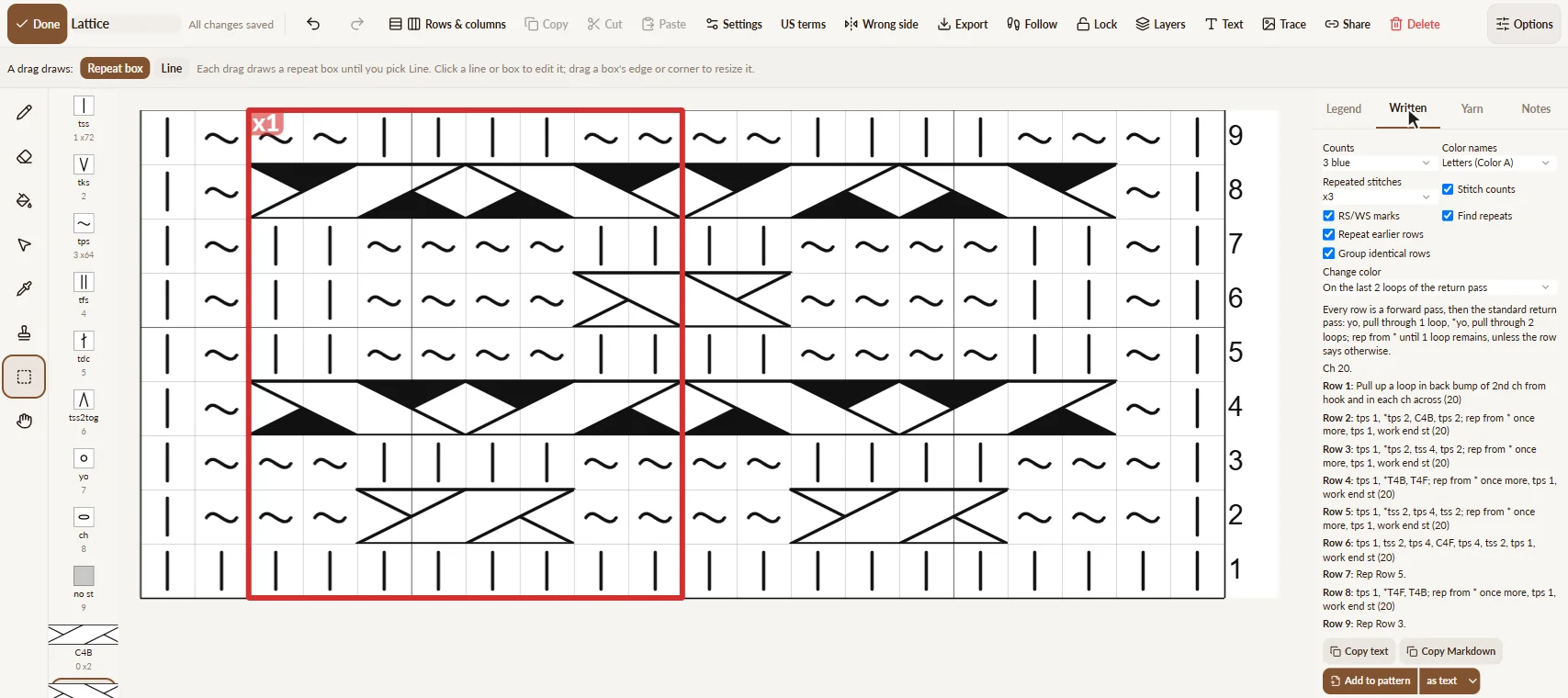
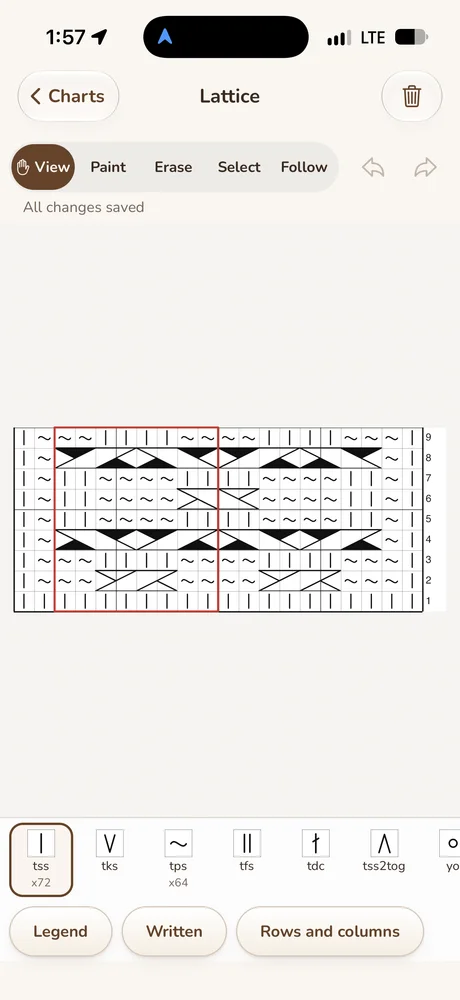
That’s a lattice from the video. The red box is a repeat box drawn where the original pattern puts its repeat bracket, so the written rows repeat exactly what that pattern repeats. Rows 7 and 9 come out as “Rep Row 5.” and “Rep Row 3.”
Colors change on the return pass
In Tunisian the new color comes in on the return pass, and patterns don’t all say it the same way. Some change on the last 2 loops, and some books change by working the first chain of the return pass in the new color. The Written tab has a Change color choice for that, and it’s saved with each chart:
- On the last 2 loops: “Return pass, changing to Color B on the last 2 loops.”
- At the first chain of the return pass: “Return pass, changing to Color B on the first ch.”
Only the words change. The chart and the stitch counts stay the same.
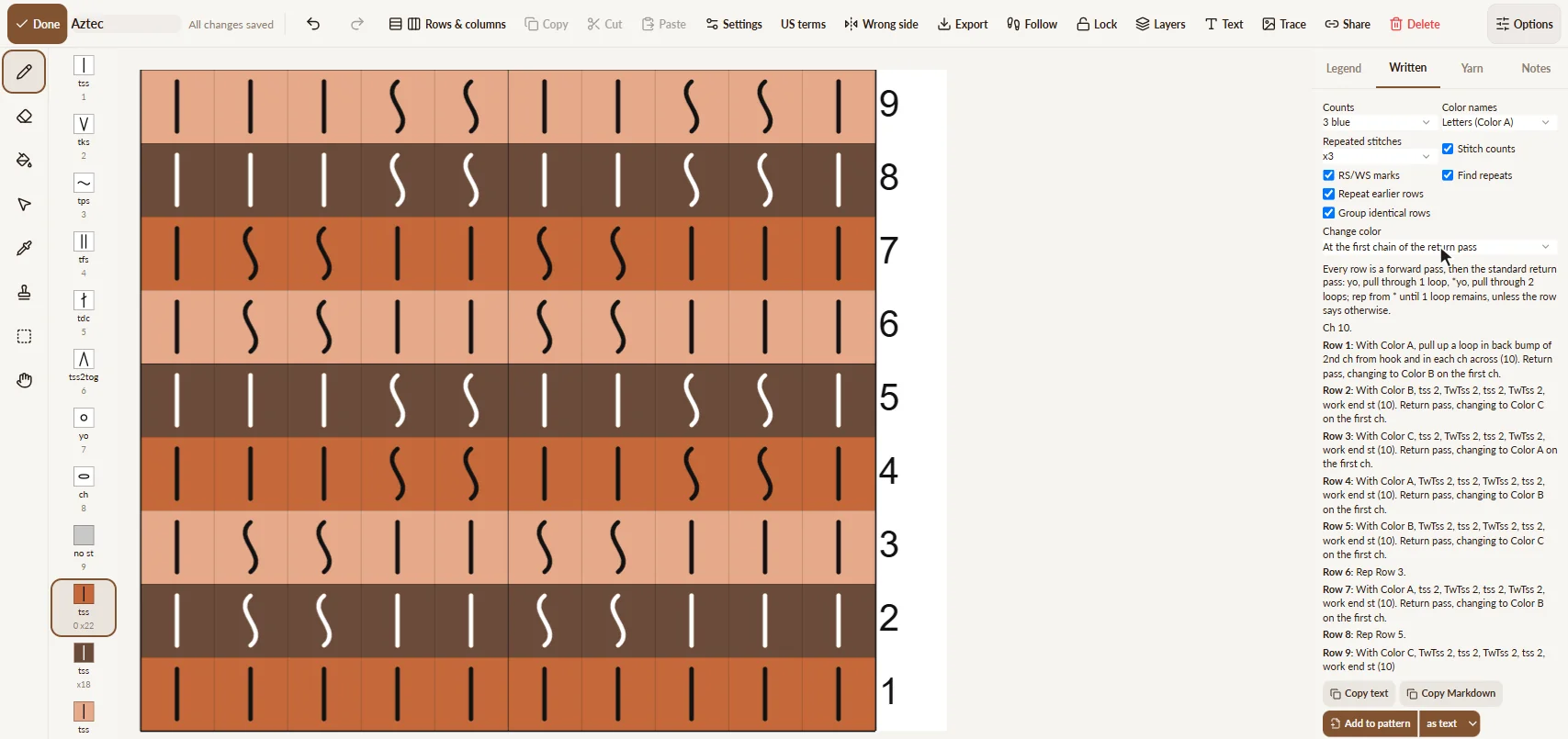
A row in several colors side by side (intarsia) says where each color changes on its return, worked from the end of the row back to the start, and the first return pass a color is worked in joins it. Any square you leave uncolored is the main color, MC.
Painting is quicker too. Pick a color swatch and paint it over a tks, a tps or a TwTss and that stitch keeps its stitch and takes the color. While you paint, the line under the chart says what will happen: “Painting with Color A: Rust: empty and tss squares become tss in this color; any other one-square stitch keeps its stitch and takes this color.”
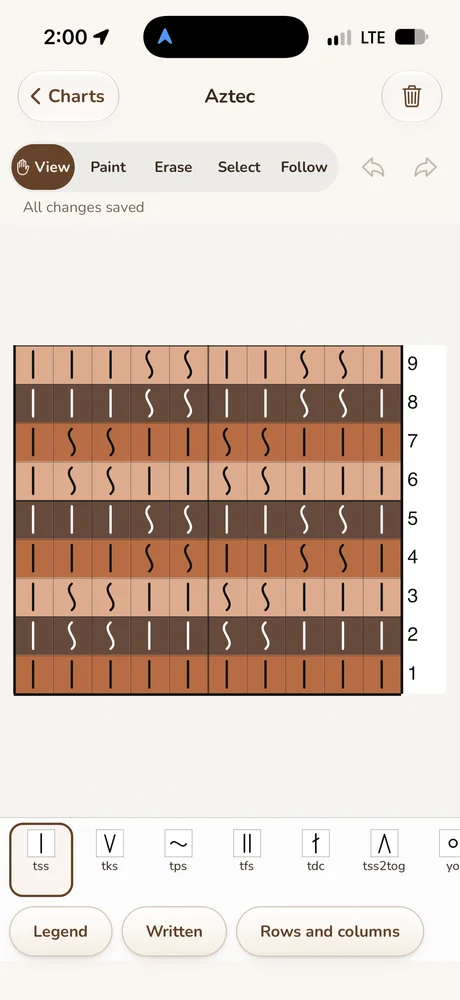
Prefer the look of your Tunisian book? In Settings, tick Draw symbols in their yarn color. The squares go white and each stitch’s symbol is drawn in its yarn color, the way many books print colorwork with stitch symbols.
The stitches
Click + in the palette and search by name. Each stitch has a symbol, and the legend prints how it’s worked after its name.
- The basics: tss, tks, tps, tfs, trs, the horizontal bar (thb), the yarn over (yo), the taller stitches (tdc, tes, ttr), and the 2 and 3 together decreases.
- Textured stitches: tpuff, Pop (popcorn), FPTdc, FpTDs, FpTEs, TwTss, tslst, etks, ttr, tss V-st, and crossed tss, tks and tdc.
- An increase: 2 tss in next st.
- Cables and twists: C3F, C3B, C4F, C4B, C6F, C6B, T3F, T3B, T4F and T4B. A cable takes as many squares as stitches it crosses, and it’s written by name.
- Bind offs: tbo, trs BO, tks sc BO and tps BO. A bind off row is written as the bind off, with no end st or return pass.
The abbreviations you’ll see most in the written rows:
| Abbreviation | Stitch |
|---|---|
| tss | Tunisian simple stitch |
| tks | Tunisian knit stitch |
| tps | Tunisian purl stitch |
| tfs | Tunisian full stitch |
| trs | Tunisian reverse stitch |
| TwTss | twisted Tunisian simple stitch |
| tslst | Tunisian slip stitch |
| tpuff | Tunisian puff |
| C4F / C4B | cable 4 front / back |
| T4F / T4B | twist 4 front / back |
| tbo | Tunisian bind off |
| end st | the last stitch of the forward pass |
Here’s every Tunisian symbol in NodeStitch, drawn by the app itself:
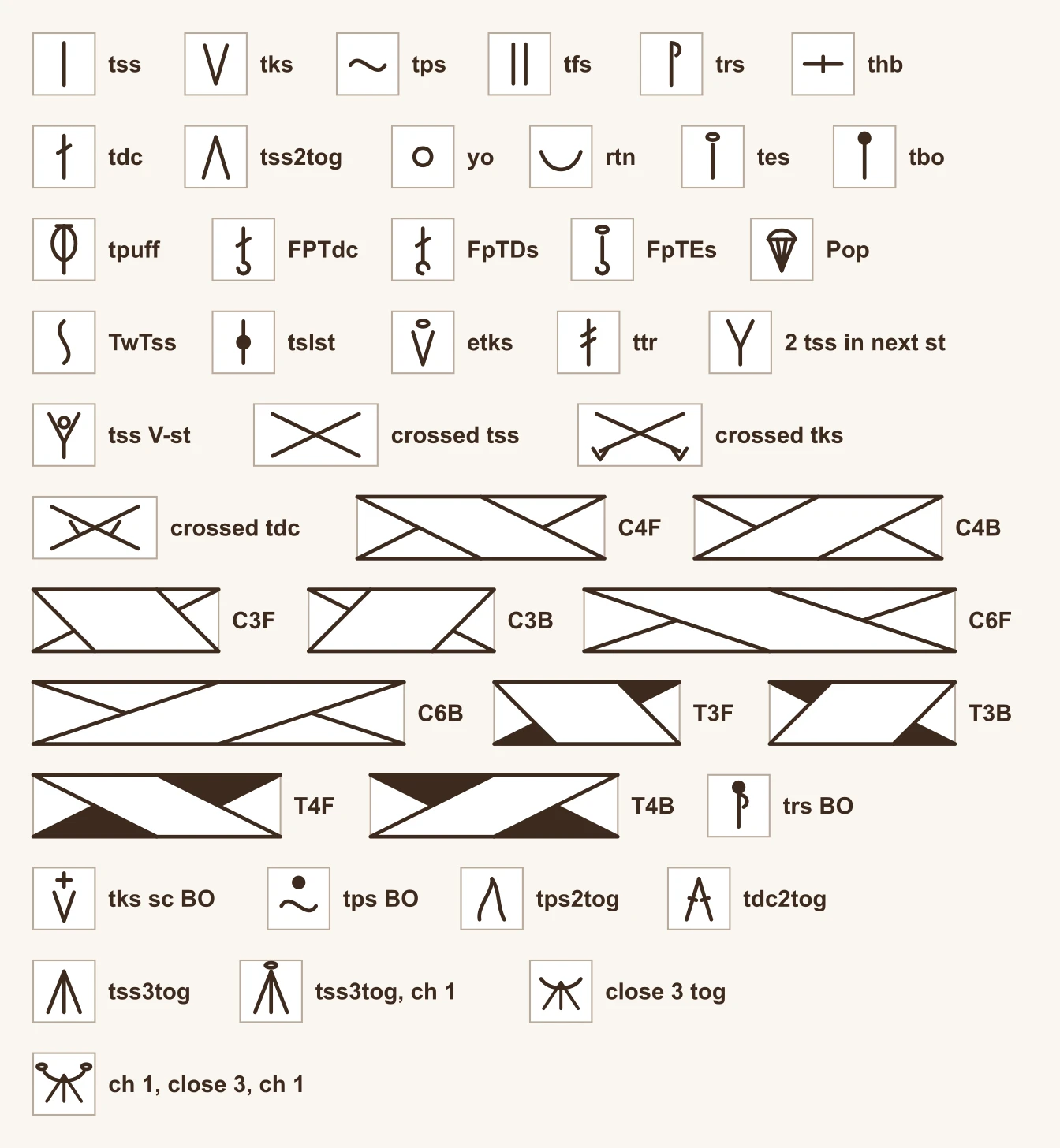
I used Anna Nikipirowicz’s Tunisian Crochet Stitch Dictionary (Landauer) as my first source for how each stitch is worked, and other sources only where the book had nothing. The cable and twist names (C4F, T4B and so on) are the book’s.
How a chart starts, and odd return passes
Under How the chart starts in the chart’s Settings:
- Foundation chain (the usual): “Ch 31.” then Row 1 in the back bumps.
- Magic ring: “Start with a MR on the hook.”
- Slip knot: no chain count, and Row 1 is written like any other row.
- Continue from live loops: for a part worked from the loops another part left.
Tick Rows start with Ch 1 and every row after Row 1 begins “ch 1”.
For a row with a different return pass, like an eyelet, type the return under Return pass for row: “ch 2, then yo, pull through 3 loops”. If it changes the stitch count, type the new count under Stitches after this return and the count check checks the next row against it. The row then shows both counts: “(13 on forward pass, 15 after return)”.
Checking a written Tunisian pattern
If your pattern is written rather than charted, Pattern Review and Count Stitches both ask what kind of crochet pattern it is first. Choose Tunisian crochet and both use Tunisian rules: the loop on the hook counts as the first stitch, and the last stitch is the end stitch. Count Stitches suggests a count for each row for you to check, and nothing is written into your pattern until you apply it. Pattern Review also warns about the two most common Tunisian mistakes, a missing last stitch and counting the loop on the hook twice. It flags what looks wrong, and nothing changes unless you choose a fix. See running a pattern review.
Tunisian charts on your phone
The NodeStitch iPhone app builds Tunisian charts too, not just shows them. Paint the chart on the phone, and Follow mode puts the forward and return passes for the row you’re on right under it, written by the same rules as the website. Tunisian is a Pro chart type on the phone as well. Pattern Review and Count Stitches are on the computer.
Below are a Tunisian cable lattice with its repeat box and a three color Aztec stripe, on an iPhone.

What it costs
Tunisian is a Pro chart type, along with corner to corner, brioche, mosaic and punch card. Pro is $9.99 a month or $99 a year. The written rows, Add to pattern, PDFs with no mark, and the share link your testers follow all come with it. The $2.99 one chart unlock doesn’t cover Tunisian, so it needs Pro.
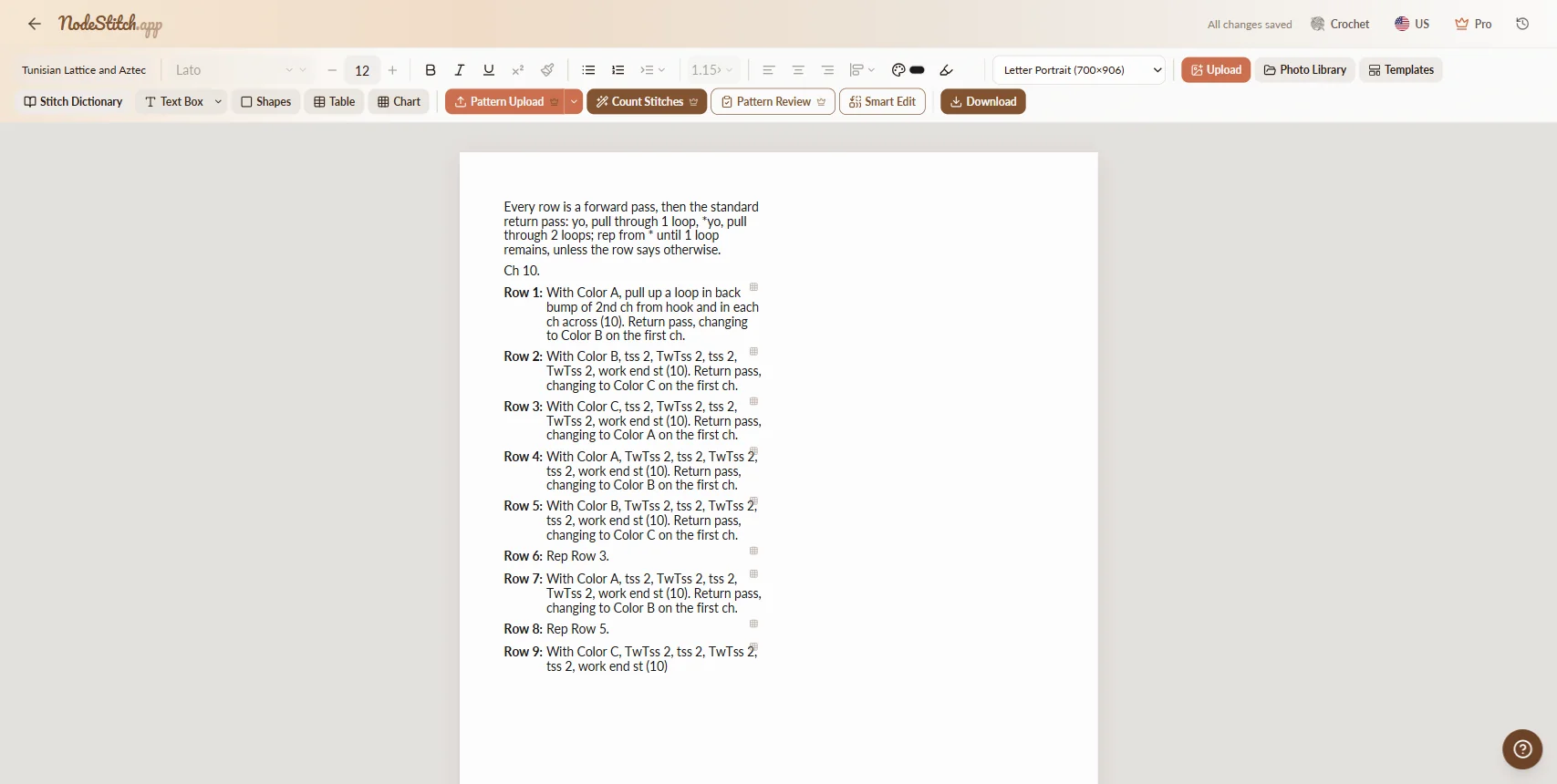
Add to pattern puts the rows on your page, and each line stays linked to its chart row. Change the chart and the lines you haven’t edited change with it. The stitch charts help article has every detail, and you can start a chart here.
Tunisian chart questions
Can NodeStitch make a Tunisian crochet chart?
Yes. Tunisian crochet is one of its chart types. Each square is one stitch of the forward pass, and the standard return pass isn’t charted.
Does it write the pattern for me?
It writes out the rows you drew on the chart, with fixed rules, so the written pattern always matches your chart. The design is yours.
Is it free?
Tunisian charts need Pro, at $9.99 a month or $99 a year. Crochet colorwork and stitch symbol charts are free to draw.
How does it handle color changes?
On the return pass. You choose whether a row says “changing to Color B on the last 2 loops” or “on the first ch”, and each chart keeps its own choice.
Can it do Tunisian cables?
Yes: C3F, C3B, C4F, C4B, C6F, C6B, T3F, T3B, T4F and T4B, each written by name and counted as the stitches it crosses.
Can I create my own symbols?
Yes. Click Custom in the palette to add a stitch of your own: draw its symbol with lines, rectangles, triangles and circles, or start from letters or a copy of a library symbol. Give it a name, an abbreviation and how many stitches it uses and makes, and it goes in the legend and the written rows like any other stitch.
Can I check a Tunisian pattern I’ve already written?
Yes. Pattern Review and Count Stitches both have a Tunisian mode that counts the loop on the hook and the end stitch the Tunisian way.
If you chart in Tunisian and something here doesn’t read the way you’d write it, tell me. That’s how most of this got built.