A double knitting chart maker that writes every pair, both faces
A double knitting chart maker draws a chart for reversible, two layer colorwork and writes every row out. In NodeStitch, each square is one stitch pair, a knit stitch on the near face and a purl stitch on the far face. Face B shows the back, and the Written tab swaps the colors on WS rows. It’s part of Pro.
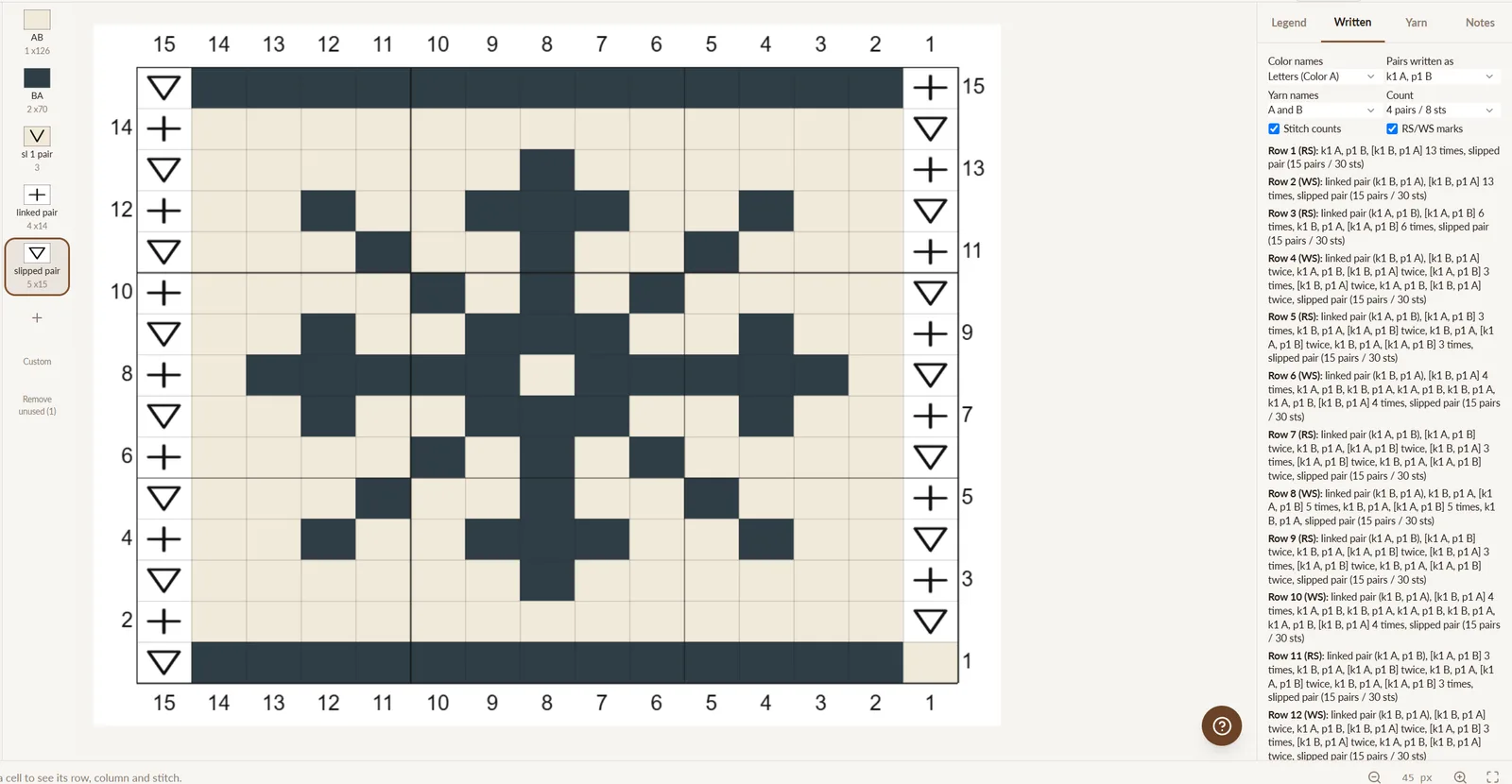
So 20 squares is 40 stitches on the needle, and every row is written as pairs, like “k1 A, p1 B”.
How I built a double knitting chart without double knitting
Same as the rest of the knitting charts: I crochet, I don’t knit. So this one was built from how published double knitting patterns, charts and keys actually write their rows. Every rule the writer follows is checked against rows from real patterns, and when NodeStitch wrote a row differently from the designer, the writer changed.
If you double knit and something here reads wrong, I want to hear about it.
One square is one pair
A new double knitting chart starts in two yarns, Cream (Color A, the first palette tile) and Dark Gray (Color B). A cream square is a pair that shows A on face A and B on face B. A dark square is the reverse. So face B is the same picture in the opposite colors, which is the whole point of reversible double knitting.
Press Face B (or W) and the editor shows the piece turned over: mirrored, every pair in the color it shows on the back. That’s where you catch the thing every double knitter learns the hard way, which is that letters read backwards on face B.
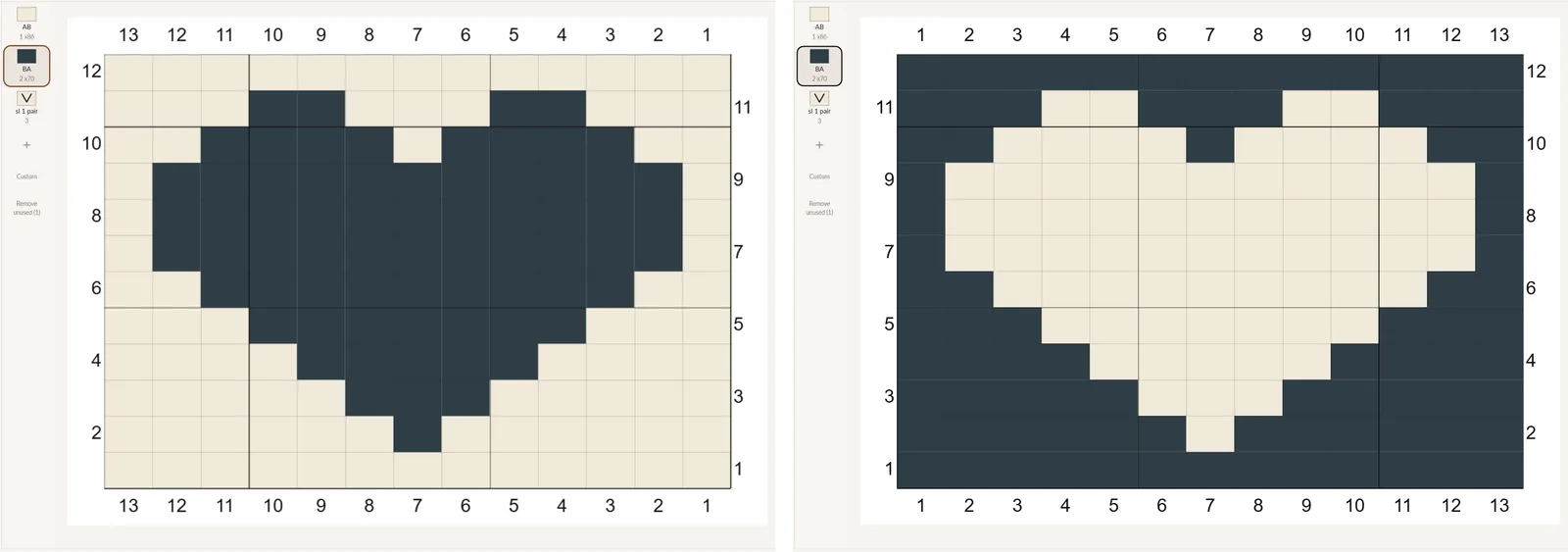
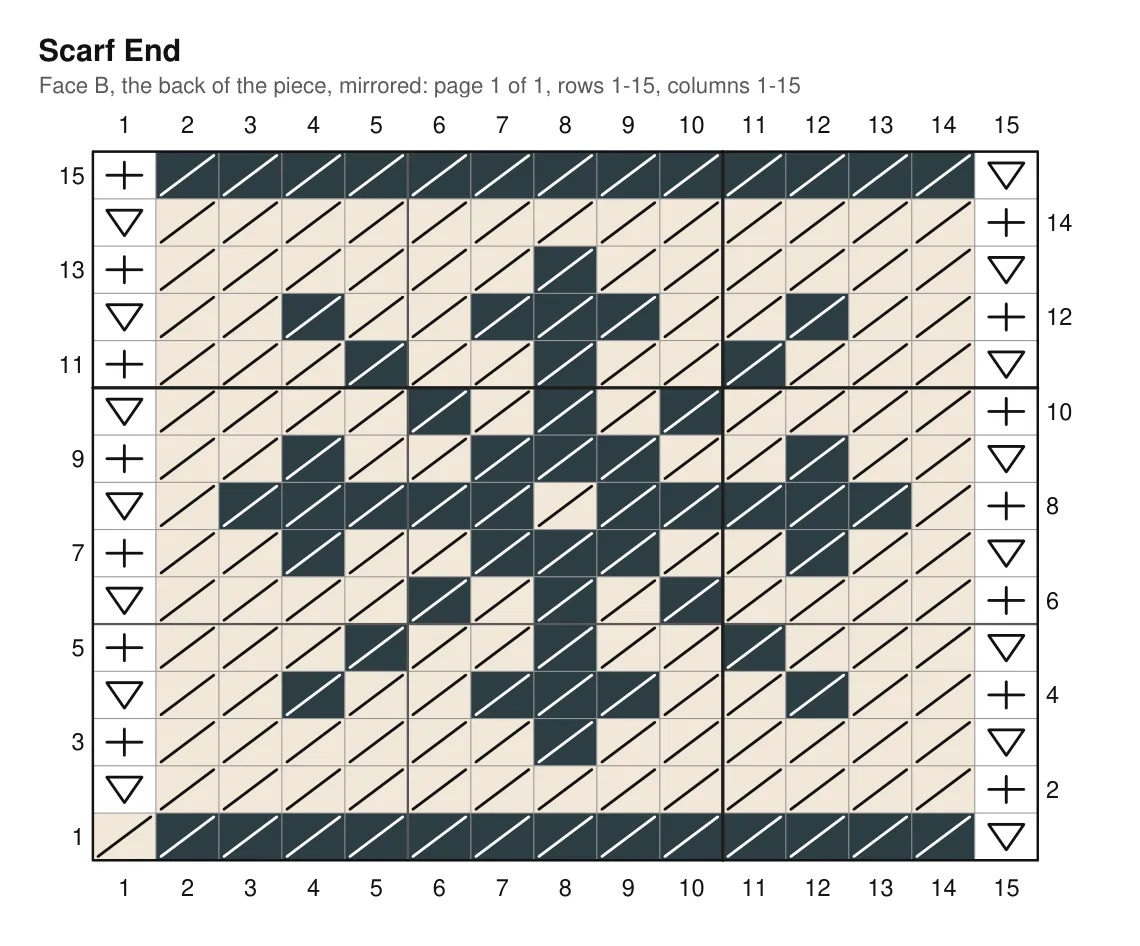
The PDF has both faces too. The chart’s Export > PDF prints the chart pages in face A’s colors, then the same pages for face B, mirrored, each pair in the color it shows there, every column keeping its number. A double knitting chart on a pattern page gets the same face B pages at the end of the pattern’s Download > PDF. If you only want face A, untick Face B pages in the chart’s Export window. To save face B as an image, switch to Face B and download a PNG or SVG.
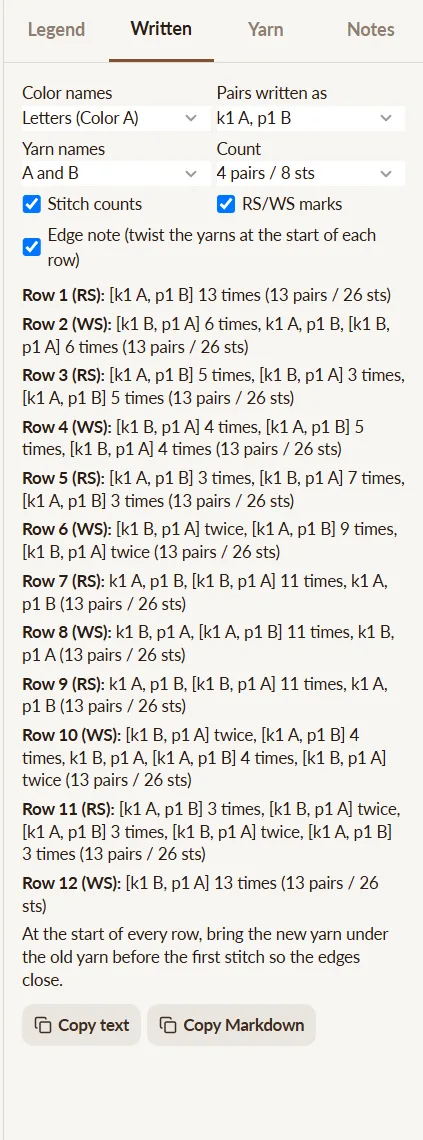
How are double knitting rows written?
Say a row is 8 squares: 2 cream, 4 dark, 2 cream. The Written tab writes it like this:
- Row 1 (RS): [k1 A, p1 B] twice, [k1 B, p1 A] 4 times, [k1 A, p1 B] twice (8 pairs / 16 sts)
- Row 2 (WS): [k1 B, p1 A] twice, [k1 A, p1 B] 4 times, [k1 B, p1 A] twice (8 pairs / 16 sts)
Row 2 has the same squares, but it’s worked from the wrong side, so the colors swap: the cream square that was “k1 A, p1 B” on the right side is “k1 B, p1 A” on the wrong side. You don’t have to do that flip in your head, and neither does your tester.
Every pair is written knit first, then purl. RS rows are read right to left and WS rows left to right. In the round every round reads right to left, as charted, with no swap. In Settings you can start Row 1 on the right side or the wrong side, or work in the round.
If you’d rather write pairs by name, set Pairs written as in the Written tab and the same row reads “2 AB, 4 BA, 2 AB”, with each name defined in the legend. Count gives you “(8 pairs / 16 sts)”, pairs only, or stitches only.
The legend gives each square both ways, so a knitter can check a pair from either side:
| Square | Right side | Wrong side |
|---|---|---|
| Cream | AB: k1 A, p1 B | BA: k1 B, p1 A |
| Dark | BA: k1 B, p1 A | AB: k1 A, p1 B |
A chart in the round has no wrong side column, since you never turn the work.
Repeats, cowls and edges
A round that repeats its pattern is written once with a repeat, the way a cowl pattern prints it. Draw the whole round, and four 26-pair repeats read “*sl 1 pair, [k1 MC, p1 CC] 12 times, …; rep from * 3 more times (104 pairs / 208 sts)”.
Edge and slip stitches are in the stitch picker’s Double knitting section, because double knitting edges aren’t one thing:
- sl 1 pair, a pair slipped inside the chart
- The linked pair and the slipped pair, charted at the start and end of a row
- Knit the edge pair together and slip the edge pair
- Single stitch selvedges, slipped or knit through the back loop, which count as 1 stitch each, not a pair: “(47 pairs + 2 edge sts / 96 sts)”
Edges are never color swapped with the motif and never pulled into a repeat. If your chart doesn’t draw its edges, Edge note in the Written tab adds one line under the rows: at the start of every row, bring the new yarn under the old yarn before the first stitch so the edges close.
The second video covers edge pairs, Make this Color A, MC and CC, Two-face, and the PDF with its face B pages.
Can lettering read right on both faces?
Plain reversible double knitting mirrors the back, so a word is backwards on face B. Two-face in Settings lets each face have its own picture, which is how double knitters get lettering to read the right way on both sides. It adds pairs knit and purled in the same yarn, A/A and B/B, written “k1 A, p1 A”. On the face you’re looking at those are the same color as the squares around them, so they’re marked with a thin diagonal line. Then you check the other side with Face B.
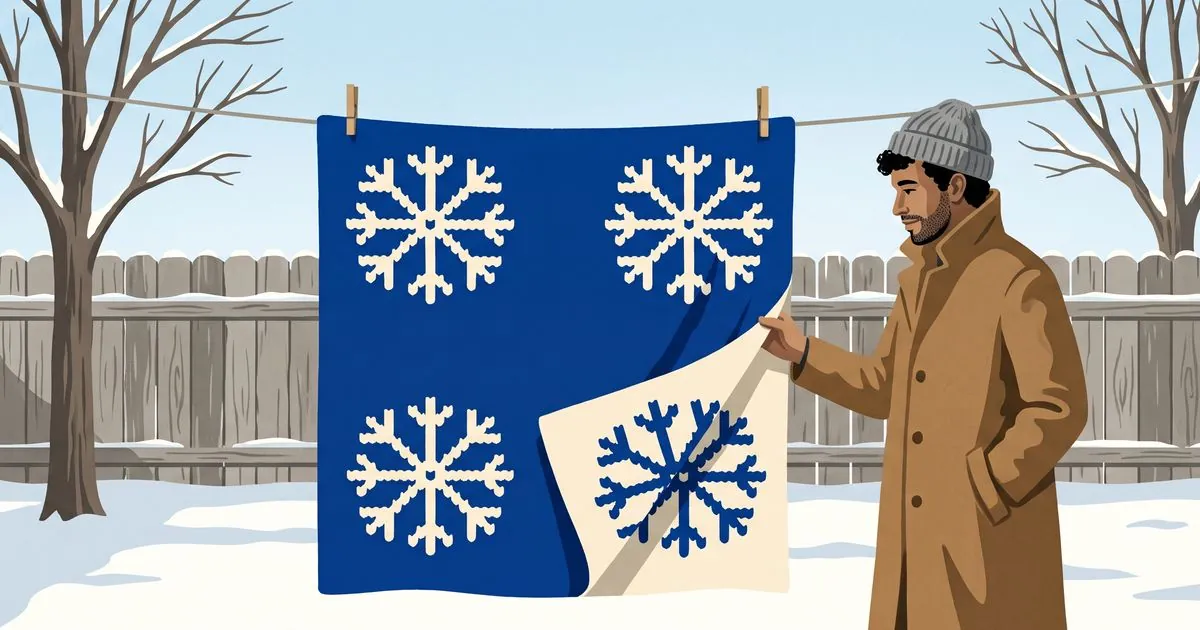
It works for pictures too. A snowflake can show dark gray on cream on both faces, instead of reversed on the back, or each face can have a different picture.
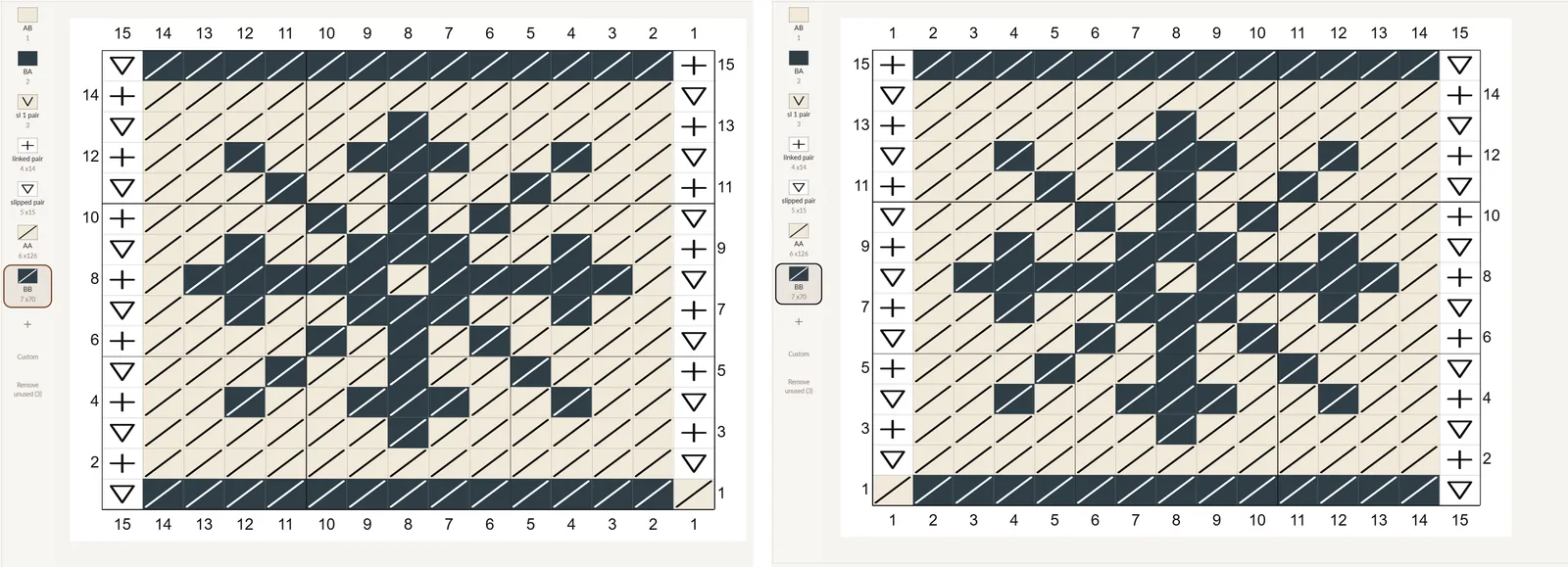
One honest catch: a whole word still has its letters in reverse order on face B unless it reads the same backwards. That’s double knitting, not the chart.
A and B, or MC and CC
Color A is the yarn on the first palette tile. On a new chart that’s the cream yarn. To swap which yarn is A, open the other yarn’s menu in the palette and click Make this Color A. The rows, the legend and the palette all change together, and Ctrl+Z swaps it back.
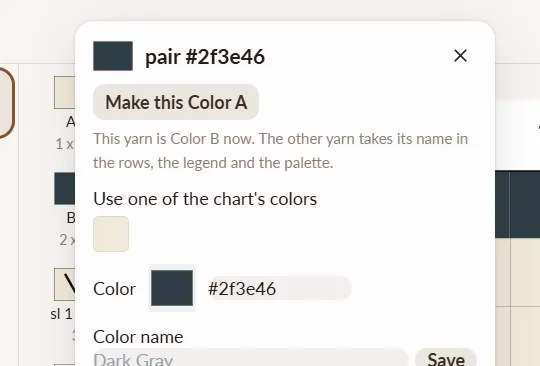
If your pattern says main color and contrast color, choose MC and CC under Yarn names in the Written tab and the rows read “k1 MC, p1 CC”. With three or more yarns they’re CC1, CC2 and so on. A name you type for a yarn yourself is used either way.
Checking the counts
Pattern Review and Count Stitches both know double knitting. Pick Double knitting when they ask what kind of knitting pattern it is, and they count pairs instead of stitches: “k1 A, p1 B” is one pair, “3 AB” is three, an edge pair is one, a single stitch selvedge is one stitch. A WS row with its colors swapped isn’t flagged as a mistake. A count written “(24 pairs / 48 sts)” is checked as a whole, so a wrong one comes back as “(25 pairs / 50 sts)”, not half corrected. Nothing in your pattern changes until you click to apply it.
What it doesn’t do yet
I’d rather you know before you start a pattern around it:
- No shaping. Increases and decreases aren’t offered, so every row has the same number of pairs.
- No cables.
- No written yarn carrying for a third color. You can paint with more than two yarns, but the rows don’t tell the knitter how to carry the extra one.
Double knitting on your phone
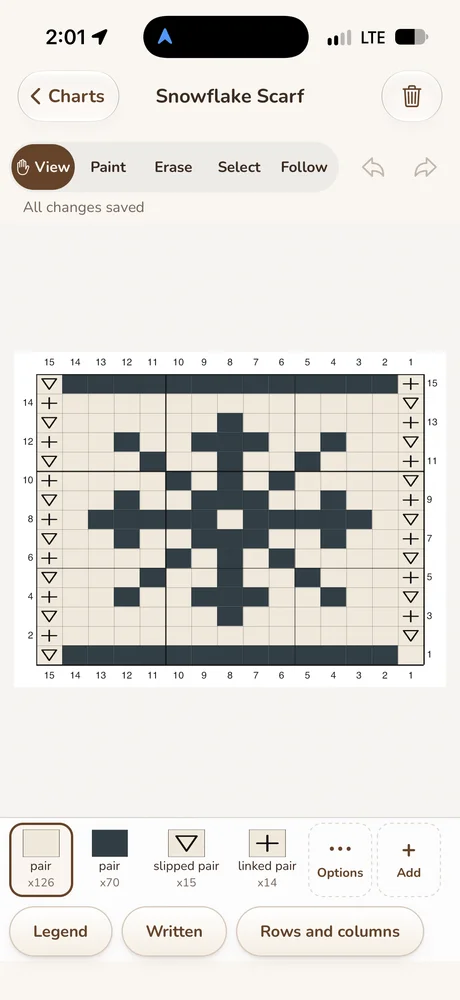
The NodeStitch iPhone app builds and follows double knitting charts too, with Pro. The written rows are the same as on the website, and changing a color recolors face B with it. The face B pages come from the chart’s PDF, and that’s made on the computer, since the phone doesn’t export chart PDFs.
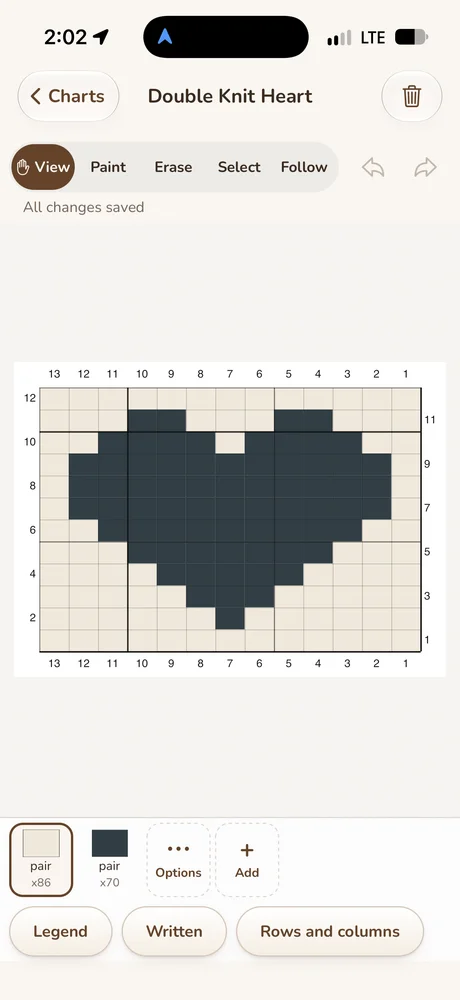
Below are a snowflake scarf, with slipped and linked pairs at the edges, and a heart, on an iPhone.

Is the double knitting chart maker free?
Double knitting is a Pro chart type, like two color brioche, mosaic, Tunisian and punch cards. Pro is $9.99 a month or $99 a year. Through November 30, 2026 (Pacific time), the yearly plan on nodestitch.app is $44.99 instead of $99, and you keep that price for as long as you stay subscribed. Canceling gives it up. Pro also gets you every written row, Add to pattern, and charts up to 1,000 x 1,000. The $2.99 single chart unlock doesn’t cover the Pro chart types, so a double knitting chart needs Pro. Plain colorwork, lace and cable charts are still free to draw, up to 300 x 300. All of what Pro includes is here.
Double knitting chart questions
How many stitches is one square?
Two. Each square is a pair, a knit stitch and a purl stitch, so a row of 20 squares is 40 stitches on the needle. The count after each row says both: “(20 pairs / 40 sts)”.
Can I see what the back will look like?
Yes. Face B in the editor shows the back of the piece, mirrored, in the colors it shows there, and the PDF prints face B pages after the face A pages, from the chart’s Export or the pattern’s Download.
Can NodeStitch write a double knitting pattern from my chart?
It writes out the rows you painted, pair by pair, with fixed rules, so the written rows always match your chart. The design is yours.
Does it work in the round?
Yes. Choose in the round in Settings and every round reads right to left with no color swap, since you never turn the work.
The stitch charts help article has every option, and the knitting chart post covers lace, cables and stranded colorwork.