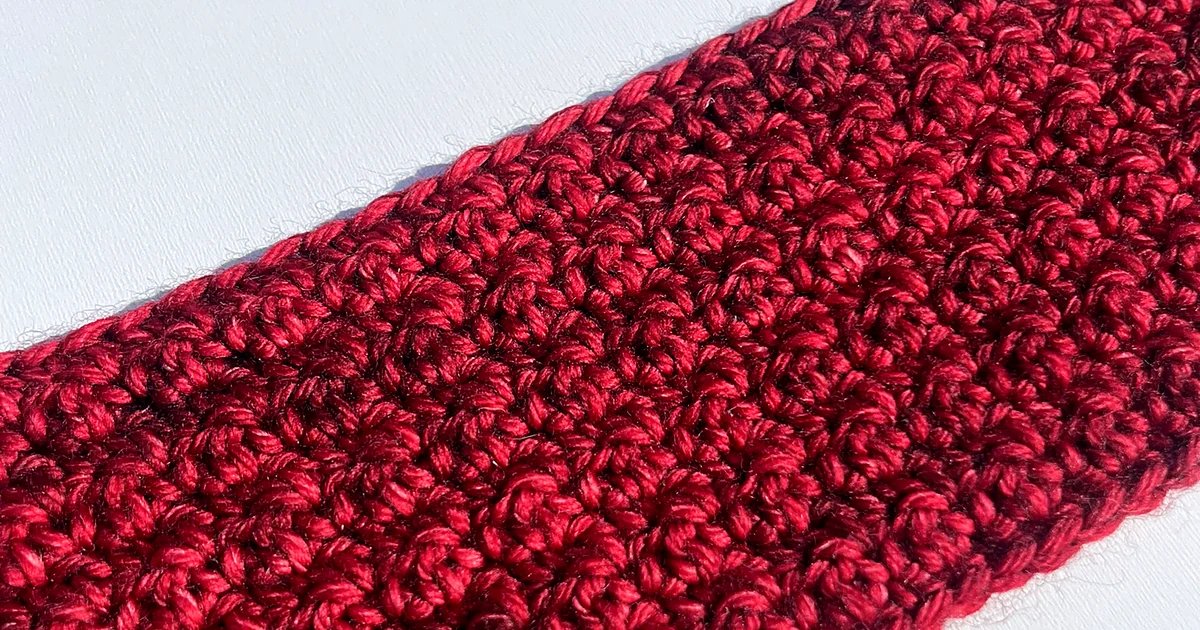
How to crochet the griddle stitch, including how to increase and decrease
The griddle stitch alternates one single crochet and one double crochet across every row, working each single crochet into the double crochet below it and each double crochet into the single crochet below it. It is a two stitch repeat over two rows, it is reversible, and it makes a dense nubbly fabric. Chain an even number to start.
I filmed three videos on it, one for the plain stitch and one each for increasing and decreasing, and this post is the written version so you have the charts and the counts in front of you while you work.
Most tutorials on a stitch pattern show you a square. You chain a length, repeat the same two rows, and end up with a swatch or a blanket. That is fine right up until you want to make an actual thing. Amigurumi is objects and creatures, so nearly everything I make has to get wider somewhere and narrower somewhere else, and the stitch pattern has to survive that.
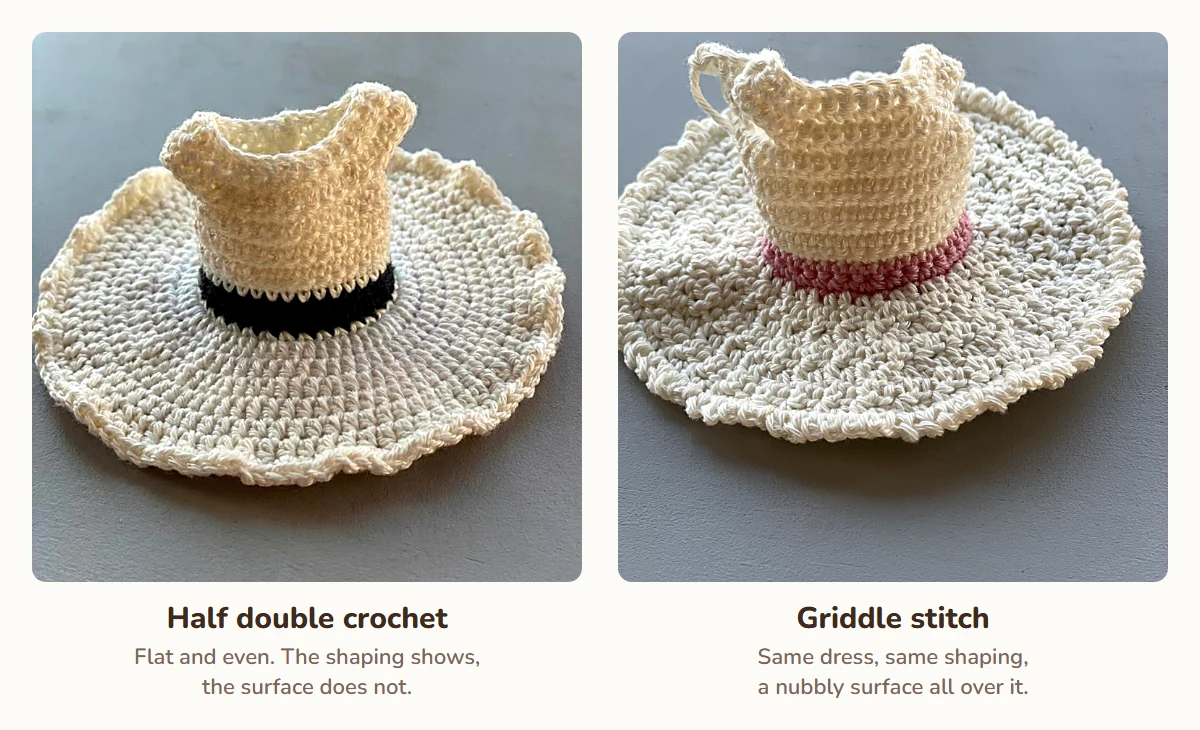
Those are two dresses for the same doll. The left one is half double crochet and the right one is griddle stitch. The shaping is the same in both, the skirt flaring out of the bodice, but the griddle one carries that nubbly texture across every bit of it, including the flare. Getting that right is the whole reason I worked out the decreases below.
What you need to know before the first row
- The stitch count is odd. You get one stitch fewer than you chained, so an even chain gives you an odd count, and an odd count is what makes every row start and end the same way.
- Chain loosely. You are going to put a double crochet into some of those chains and a tight chain is miserable to get a hook into.
- I work into the back bumps of the foundation chain rather than the top loops. The first bump is hard to see. It makes a tidier, tighter edge, but the front loops work fine if you prefer them.
- Single crochet always sits on a double crochet, and double crochet always sits on a single crochet. That one sentence is the whole pattern. If you lose your place, look at the row below: the double crochets are looser and longer, the single crochets are tighter.
The griddle stitch, row by row
This is written for eleven stitches, which is what I used in the video.
Foundation: ch 12.
Row 1: sc in the 2nd ch from the hook, then *dc in the next ch, sc in the next ch* across. Ends with a sc. (11 sts)
Row 2: ch 3, turn. The ch 3 counts as your first dc. Skip the first stitch, sc in the next stitch, then *dc in the next st, sc in the next st* across. Ends with a dc. (11 sts)
Row 3: ch 1, turn. Sc in the first stitch, then *dc in the next st, sc in the next st* across. Ends with a sc. (11 sts)
Repeat rows 2 and 3.
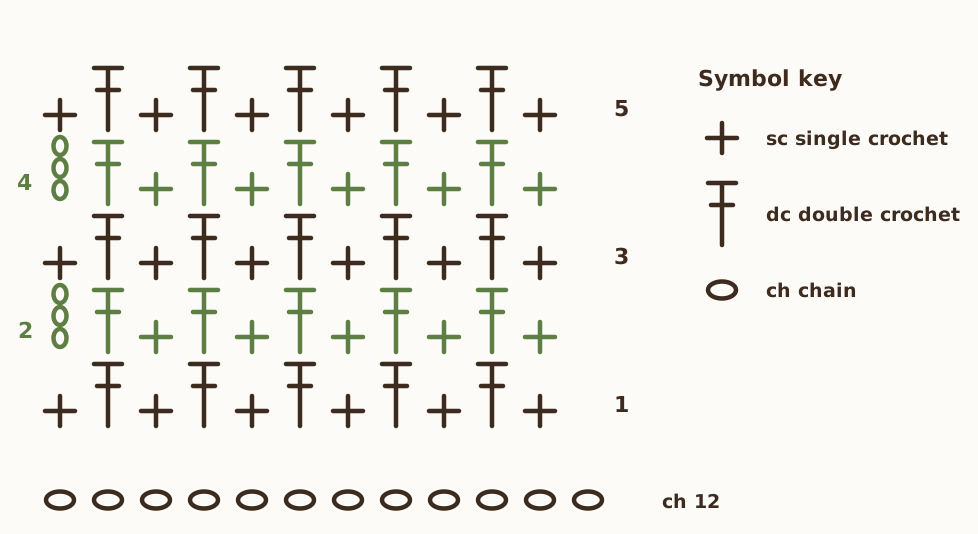
You do not have to skip that first stitch after the ch 3. You can work a single crochet into it instead and it comes out the same. I skip it because the edge looks cleaner to me.
How to tell you are on track
Rows tell you themselves whether they went right:
| The row started with | The row should end with |
|---|---|
| A single crochet (after ch 1) | A single crochet |
| Ch 3, which counts as a double crochet | A double crochet |
If you started with a single crochet and ran out of stitches on a double crochet, something went wrong earlier in that row. Usually you skipped a stitch without meaning to. The other thing that happens is two single crochets back to back, or two double crochets back to back, so go back along the row you are on and look for both.
Increasing in griddle stitch
Two rules do all the work here:
- Only increase into a single crochet from the row below. That is the tighter stitch, and it is the one with room to take two more.
- The increase is dc, ch, dc, all three into that same stitch. That adds two stitches.
Keep the chain in the middle loose. You have to get a double crochet into it on the next row.
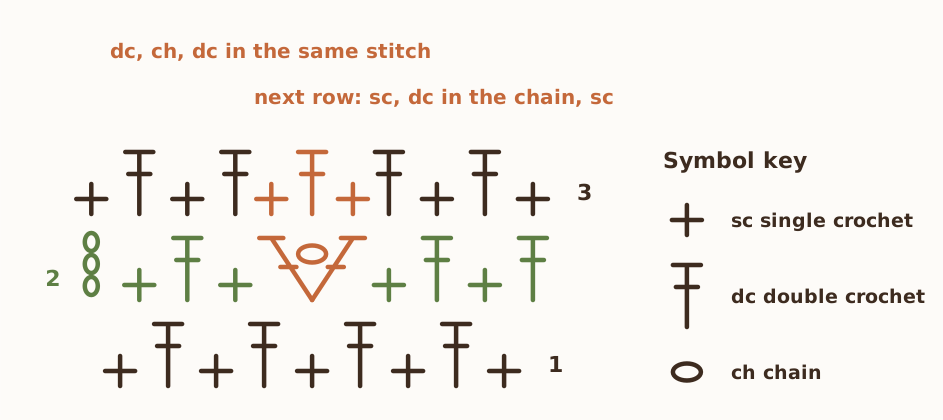
On the next row, treat that chain as a stitch. So across the increase you work a single crochet into the first double crochet, a double crochet into the chain, and a single crochet into the second double crochet. Then carry on with the alternation as if nothing happened.
Count the chain when you count your stitches. I started with 11 stitches, did one increase, and had 13. On the next row I did three increases and had 19.
Decreasing in griddle stitch
This is my own method. I have not seen it anywhere, including in the stitch books I own, and it came out of wanting my decreases to balance my increases without wrecking the texture.
The rule: whatever stitch would come next in the pattern, that is the kind of decrease you make. Next stitch is a double crochet, so you make a dc2tog. Next stitch is a single crochet, so you make a sc2tog.
Then the part that makes it work: decreases come in pairs, and the second one is the other kind. A dc2tog is followed immediately by a sc2tog. A sc2tog is followed immediately by a dc2tog. Each pair takes out two stitches, which is exactly what one increase puts in.
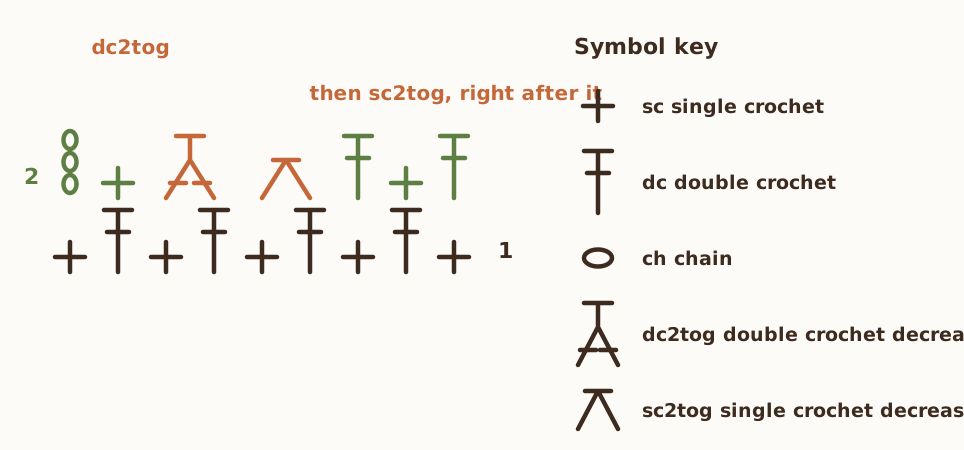
Pairing them is not a style choice. One decrease on its own leaves two single crochets or two double crochets sitting next to each other, and the alternation is broken from there to the end of the row.
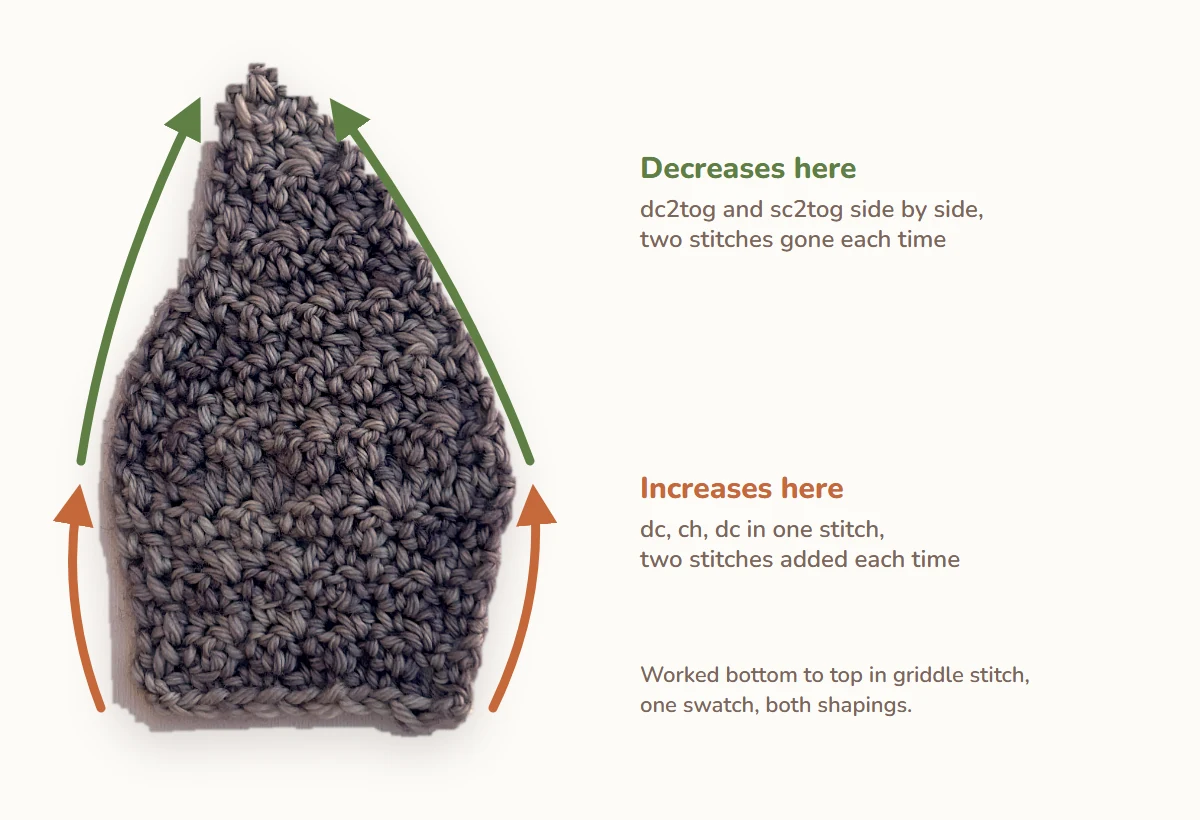
That swatch is one piece: increases up the lower half, decreases up the top half. The texture runs straight through both.
The counts from the video
| Row | What I did | Stitch count |
|---|---|---|
| Starting row | Plain griddle | 11 |
| Increase row | One increase | 13 |
| Increase row | Three increases | 19 |
| Decrease row | Three decrease pairs | 13 |
Nineteen back down to thirteen, which is where I was before the big increase row. If your count does not land where it should, you almost certainly missed counting a chain from an increase.
Writing this down as a pattern
Shaped rows are where my own patterns used to go wrong. A row that says increase three times is fine until you write the count at the end of it and have to stop and work out whether it is 17 or 19, and whether you counted the chains.
I put the counts in as I go now, in NodeStitch, and its Pattern Review flags rows where the count does not follow from the row before. It does not write the pattern and it does not fix anything, it just tells me the number I typed and the number it worked out do not match, which is the error I make most.